

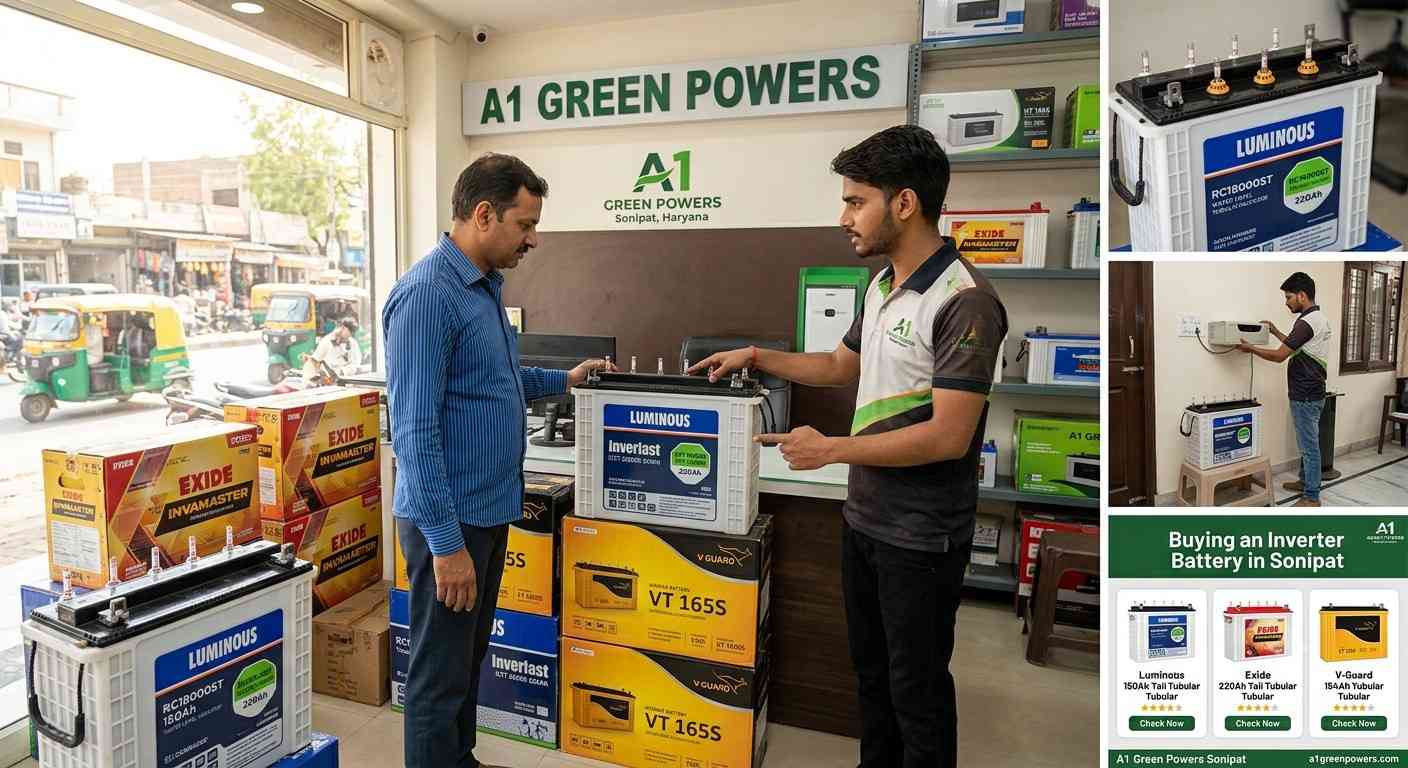
Introduction
Let me tell you something that most battery shops in Sonipat won’t.
A bad battery doesn’t fail on day one. It fails at the worst possible time—peak summer, 2 PM, when the power’s gone and your inverter clicks on, runs for forty minutes, then dies. And by then, the guy who sold it to you has either forgotten your name or changed his number.
That’s not a hypothetical. That’s what happens when people buy inverter batteries based purely on price, from a shop with no real accountability.
Sonipat has no shortage of shops selling inverter batteries. Walk down any market—Sector 14, Old Sonipat, near the railway station—and you’ll find someone happy to sell you a battery. What’s harder to find is someone who’ll actually help you pick the right one, match it correctly to your inverter, explain the warranty in plain language, and still be reachable six months later.
That gap is exactly what A1 Green Powers fills. As a manufacturer based out of the Kundli Industrial Area right here in the Sonipat district, they’re not a middleman reselling someone else’s product. They make inverter batteries—lithium ones especially—and sell them directly to customers. Which means better prices, real accountability, and no runaround when something needs sorting.
This article covers everything you should know before you spend money on an inverter battery in Sonipat—from figuring out what capacity you actually need to understanding why the cheapest option almost always ends up being the most expensive one.
Why Power Backup Still Matters in Sonipat (And Why Most People Get the Battery Wrong)
Power cuts in Haryana haven’t gone away. Sonipat sees load shedding regularly through summer — sometimes 4 to 6 hours a day in residential areas. Industrial zones have their own fluctuation problems. And anyone running a small business from home knows that even a 30-minute outage can kill a day’s work.
Inverters solve the problem. But only if the battery behind them is the right one.
The Mistake People Keep Making
Most buyers walk into a shop, ask for “a battery for my inverter,” get told the price, maybe haggle a bit, pay, and leave. Nobody asks what appliances they’re running. Nobody checks if the battery is compatible with the inverter brand. Nobody explains what the warranty actually covers.
Three months later, the backup time is already shorter than expected. A year later, the battery needs replacement. And the shop? They’ll sell you another one.
This isn’t a one-off bad experience. It’s disturbingly common in Sonipat’s unorganized battery retail market.
What Should Actually Happen
A good inverter battery shop — and the term “shop” barely covers what A1 Green Powers does — starts by asking you questions. How many hours of backup do you need? What appliances are you running? What inverter do you have? Do you have solar panels, or are you planning to install them?
Only after understanding your setup should any recommendation happen. That’s the baseline of decent service, and it’s something A1 Green Powers has built into how they work with every customer.
What Kind of Inverter Battery Do You Actually Need?
There are three main types of inverter batteries in the market right now. Each has a different price point, maintenance need, and lifespan. Knowing the difference before you walk into any inverter battery shop in Sonipat will save you a lot of money and frustration.
Flat-Plate Lead-Acid Batteries
These are the old workhorses. Cheap upfront, widely available, and fine for areas with very infrequent, short power cuts.
The problem is they deteriorate fast with regular deep discharge. If your area faces 4+ hours of cuts daily, a flat-plate battery will wear out in 18 months to 2 years. You’ll also need to add distilled water regularly. And they’re heavy — moving one isn’t a casual activity.
For most homes in Sonipat, flat-plate batteries are a false economy. You save ₹2,000 upfront and lose ₹8,000 over three years in early replacement and maintenance.
Tubular Lead-Acid Batteries
Tubular batteries are significantly better. The design of the positive plate means they handle deep discharge cycles far more reliably. A quality tubular battery in a normal Sonipat home — moderate load, 4–5 hours of cuts — should last 4 to 5 years with basic upkeep.
They still need water top-ups every 3–4 months, and they’re not light. But for buyers who want proven technology at a reasonable price, a tubular is the sensible middle ground.
A1 Green Power stocks quality tubular batteries compatible with all major inverter brands—Luminous, Microtek, Su-Kam, Exide, and others.
Lithium (LiFePO₄) Batteries — The Newer, Better Option
This is where things have genuinely changed in the last three years.
Lithium iron phosphate batteries—LiFePO₄—are a different category. They’re lighter (sometimes one-third the weight of a comparable lead-acid battery), they charge much faster, they maintain consistent performance across thousands of cycles, and they need absolutely zero maintenance. No water. No acid checks. No terminal cleaning.
A1 Green Powers manufactures lithium batteries in-house at their Kundli facility. That’s an important distinction. They’re not importing a product and rebadging it. They build it, test it, and back it with a 10-year warranty — which is genuinely rare in this market.
For anyone in Sonipat who deals with daily power cuts, the lithium option is worth the higher upfront cost. The math almost always works out better over five years.
How to Size Your Battery Correctly — Before Anyone Tries to Sell You One
Here’s a practical guide that most salespeople won’t give you, because it might lead you to buy a smaller (cheaper) battery than they’d prefer to sell.
Step One — Write Down Your Actual Load
List every appliance you want to run during a power cut. Don’t guess. Check the wattage on the back of each device or look it up.
A typical Sonipat home setup might look like:
- 3 ceiling fans: 3 × 65W = 195W
- 6 LED bulbs: 6 × 9W = 54W
- 1 LED TV (32″): ~60W
- 1 WiFi router: ~10W
- Total: roughly 320W
Step Two — Decide How Many Hours of Backup You Need
If you want 4 hours of backup for the above load, here’s the rough calculation:
Required battery capacity (Ah) = (Load in Watts × Hours) ÷ (Battery voltage × Efficiency)
Plugging in the numbers: (320 × 4) ÷ (12 × 0.8) = 1280 ÷ 9.6 = 133 Ah
So a 150Ah battery gives you a comfortable margin. A 100Ah battery will fall short.
Step Three — Make Sure Your Inverter Matches
Your battery capacity also needs to align with your inverter’s output rating. A 600VA inverter handles around 480W of load. If your load is 600W, you need a 900VA inverter. Mismatching here damages both the inverter and the battery over time.
The A1 Green Powers team walks every customer through these calculations. You don’t need to do this alone — just come in with a rough idea of your load, and they’ll take it from there.
Why A1 Green Powers Stands Apart from Other Inverter Battery Shops in Sonipat
There’s an honest answer and a diplomatic one. I’ll give you the honest one.
Most shops in Sonipat selling inverter batteries are traders. They buy from a distributor, mark it up, and sell. There’s nothing inherently wrong with that — but it means you’re dealing with someone who has no real connection to the product, no ability to resolve warranty issues quickly, and no technical depth when things go wrong.
A1 Green Power & Renewable Solution Pvt. Ltd. is a manufacturer. Based in Kundli Industrial Area, they make lithium batteries and solar products on-site. They also manufacture inverters, solar PCUs, and EV batteries. When you buy from them, you’re buying from the source.
What That Actually Means for You
Better pricing. No distributor margin sitting between the manufacturer and you.
Real warranty support. If something goes wrong, you’re talking to the people who built it—not a call center reading from a script.
Informed advice. Their team understands the products at a technical level. They can tell you why a 150Ah lithium battery from their factory will outperform a 200Ah flat-plate battery from an unknown brand. That context matters.
Local presence. Kundli Industrial Area is well within the Sonipat district. You’re not dealing with a distant company—they’re your neighbors, effectively.
The Product Range
Beyond inverter batteries, A1 Green Powers also stocks:
- Wall-mounted and floor-standing lithium home batteries
- Solar batteries for grid-tied and off-grid systems
- Hybrid, on-grid, and off-grid inverters
- Power Control Units (PCUs)
- EV batteries for e-rickshaws, e-scooters, and electric loaders
- Complete rooftop solar systems
If you’re planning to go solar at any point — even a few years from now — it makes sense to buy a battery that’s solar-compatible from the start. A1 Green Powers can help you future-proof your purchase.
Things to Check Before Buying from Any Inverter Battery Shop in Sonipat
Whether you buy from A1 Green Powers or anyone else, here are the questions you should always ask. A shop that answers these confidently is worth trusting. One that fumbles or deflects probably isn’t.
Is the Warranty Full Replacement or Pro-Rated?
This is the most important question and the most commonly skipped.
A “3-year warranty” sounds great until you read the fine print: if the battery fails at 18 months, you get a 50% credit toward a replacement — not a new battery. That’s a pro-rated warranty, and it’s almost standard practice in the cheaper segment.
Full replacement warranties are rarer and worth significantly more. A1 Green Powers offers transparent terms—ask them directly and they’ll tell you exactly what’s covered.
Can They Show You Actual Specifications?
Capacity ratings can be inflated. A battery labeled 150Ah should actually deliver close to 150Ah under real conditions. Ask for spec sheets. A legitimate manufacturer will have them.
What’s the Manufacturing Date?
Lead-acid batteries lose capacity if stored too long before sale. Always check the manufacturing date on the battery. Anything older than 3–4 months sitting on a shelf is worth questioning.
Lithium batteries are more forgiving on storage, but it’s still a good habit.
Do They Service What They Sell?
Can they send a technician if installation goes wrong? Will they come to your location in Sonipat if there’s a complaint? Getting clear on this before buying saves a lot of headache afterward.
Conclusion
An inverter battery in Sonipat isn’t complicated—but buying the right one from the right place takes a bit more thought than most people give it. In Sonipat, the options range from fly-by-night roadside counters to established manufacturers like A1 Green Powers. The gap between them isn’t just price—it’s knowledge, accountability, and the likelihood that your battery is still performing well three years from now.
If you want honest advice, the right battery for your actual setup, and a warranty that means something, A1 Green Powers in Kundli Industrial Area is where you should start.
Visit them, call them, or browse their full product range at a1greenpowers.com. Tell them your load and your inverter, and they’ll do the rest.
Power backup is one of those things you only appreciate when it’s working. Get it right the first time.
Frequently Asked Questions
Q1. Which is the best inverter battery shop in Sonipat for home use? A1 Green Powers in the Kundli Industrial Area is among the most reliable options in the Sonipat district. They’re a manufacturer — not a reseller — which means better pricing, genuine warranties, and staff who actually understand the products they’re selling.
Q2. What’s the difference between a tubular battery and a lithium battery for inverters? Tubular batteries are lead-acid-based. They’re affordable, work with all standard inverters, but need regular water top-ups and last about 4–5 years. Lithium batteries—specifically LiFePO₄—are maintenance-free, lighter, charge faster, and can last 8–10 years. A1 Green Powers manufactures both types.
Q3. How do I know what battery capacity I need? Add up the wattage of all appliances you want to run during a power cut, multiply by the number of backup hours you need, then divide by your battery voltage (usually 12V) and efficiency factor (roughly 0.8). A 150 Ah battery suits most standard homes in Sonipat with 4–5 hours of backup requirement.
Q4. Can I use a lithium battery with my existing inverter in Sonipat? It depends on your inverter model. Some older inverters aren’t compatible with lithium batteries without a firmware update or replacement. A1 Green Powers can assess your current setup and advise you—sometimes a simple setting change is enough; other times a compatible inverter is the better route.
Q5. How much does a good inverter battery cost in Sonipat? Quality tubular batteries start around ₹8,000–₹14,000 depending on capacity. Lithium batteries are priced higher — typically ₹18,000 onwards — but the cost per year of use is often lower when you factor in a 10-year lifespan and zero maintenance. Contact A1 Green Powers for current prices specific to your requirement.
Q6. Does A1 Green Powers deliver inverter batteries in Sonipat? Yes. A1 Green Powers serves customers across Sonipat and surrounding areas, including Kundli, Murthal, Gohana, and neighboring localities. Contact them at a1greenpowers.com to confirm delivery for your area.
Q7. What warranty does A1 Green Powers offer on inverter batteries? Their lithium batteries come with a 10-year warranty. They also offer transparent terms on lead-acid products. Unlike many retailers who use pro-rated warranty structures, A1 Green Powers is straightforward about what’s covered and for how long.
Q8. I’m also thinking of going solar. Can A1 Green Powers help with that? Absolutely. A1 Green Powers is a full-range renewable energy manufacturer—they make solar panels, solar batteries, hybrid inverters, and PCUs. If you’re planning a rooftop solar system in Sonipat, buying your battery from them now means you can easily integrate solar later without compatibility headaches.

Leave A Comment