


Introduction
Let me be straightforward with you. If you live in Uttar Pradesh and you are thinking about solar, you have probably already seen dozens of local dealers quoting you prices on Chinese panels with no real warranty support. I have spent nearly a decade working in this industry across UP, Haryana, and Rajasthan. The one complaint I hear most from homeowners and factory owners alike is this—”We bought cheap panels three years ago, and now nobody picks up the phone.”
That is the real problem. And that is exactly why finding the right TOPCon solar company in UP matters more than just finding the cheapest quote.
A1 Green Power & Renewable Solution Pvt. Ltd. is a manufacturer, not a trader. There is a difference. They make their own TOPCon solar modules, their own LiFePO4 lithium batteries, and their own inverters at their Sonipat facility. When something goes wrong — and over 25 years, something always does — you are talking directly to the people who built your system, not a middleman who has since disappeared.
In this article, I want to walk you through everything you need to know before making your solar decision in UP. We will cover the technology, the products, the government subsidies available right now, and how to actually get the most out of your investment.
What Makes TOPCon Different — And Why It Matters in UP’s Heat
Most people shopping for solar in the UP have heard the word “TOPCon” by now, but very few have had it properly explained to them. So let me break it down simply.
The real story behind solar efficiency
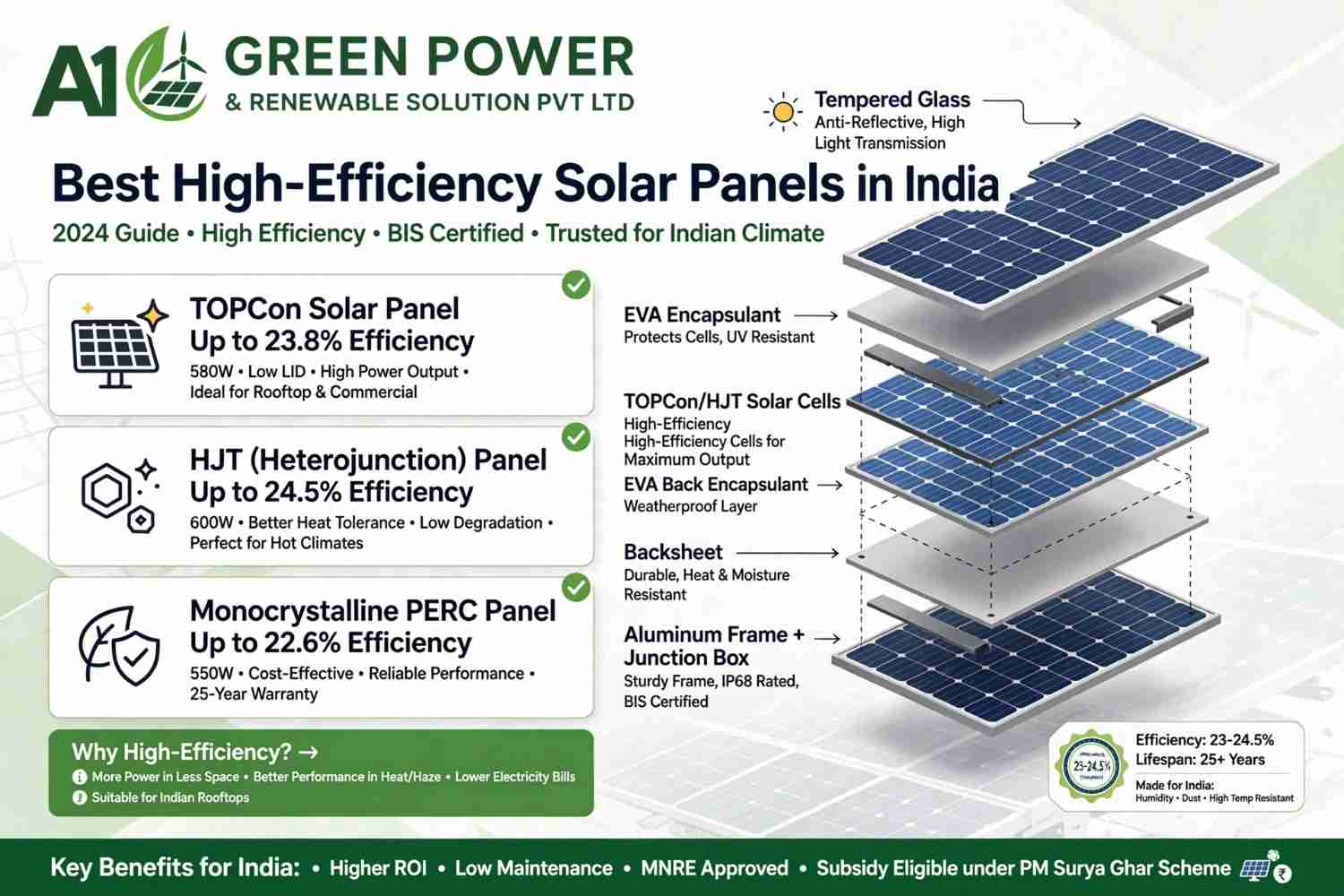
Solar panels work by converting sunlight into electricity. The efficiency percentage tells you how much of the sunlight that hits the panel actually becomes usable electricity. A standard PERC panel — which was the industry standard until about two years ago — converts around 20 to 21 percent.
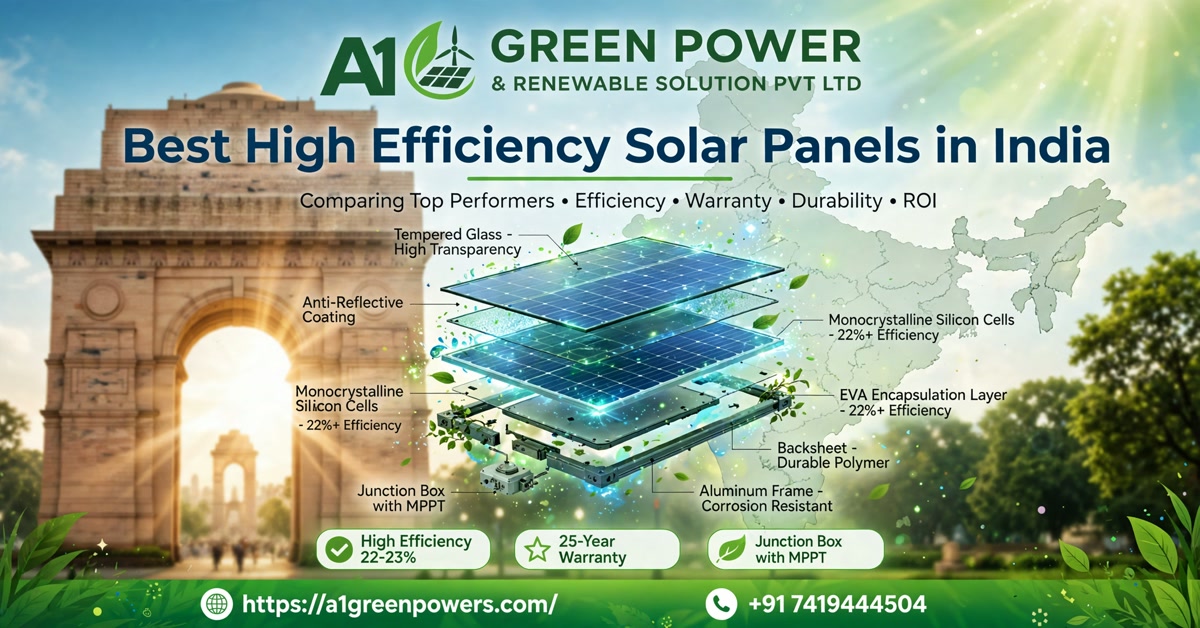
A TOPCon panel does 22 to 23 percent. That gap sounds small until you do the math on a rooftop.
Say you have 40 square meters of south-facing roof in Lucknow. With PERC panels, you might fit a 6 kW system. With TOPCon panels of the same size, you get closer to 6.8 or even 7 kW from the same roof space. Over a year in UP’s climate, that difference adds up to hundreds of extra units of electricity—and hundreds of rupees in savings every single month.
The temperature problem nobody talks about
Here is something most solar dealers in UP will never mention to you. Solar panels lose efficiency as they heat up. Every degree above 25°C causes the panel to produce slightly less power. This is measured as the temperature coefficient.
PERC panels typically have a temperature coefficient of around -0.35% per degree Celsius. TOPCon panels are around -0.29% or better.
In Agra or Varanasi in May, when your rooftop is hitting 55°C or more, that difference is real and measurable. TOPCon panels hold their performance better through UP’s brutal summers. Over the lifetime of the system, this means meaningfully more units generated compared to older technology.
A1 Green Power’s TOP Con modules are tested under exactly these kinds of extreme conditions. Thermal cycling, mechanical load, PID resistance — the full suite. That is not marketing language. It is what separates a manufacturer serious about quality from someone just importing containers and rebadging them.
A1 Green Power: What Kind of Company Are We Actually Talking About?
Built in India, tested by some serious clients
A1 Green Power is not a startup. They have been in the renewable energy manufacturing business for over five years and have built a client list that genuinely surprised me when I first looked into them.
Hyundai, Mahindra, and Haldiram’s. Yamaha. Lupin Pharmaceuticals. IIT Madras.
These are not small buyers who accepted whatever was given to them. These are companies with procurement teams, quality auditors, and strict vendor approval processes. The fact that A1 Green Power passed those processes and continues to supply to these clients tells you something important about their manufacturing standards.
Their facility is at Plot No. 19, Sector 56, Phase-4, HSIIDC, Kundli Industrial Area, Sonipat, Haryana. It is a proper industrial setup with in-house EL testing—that stands for Electroluminescence testing, which is how you detect invisible micro-cracks in solar cells before they leave the factory. Most small manufacturers skip this. A1 Green Power does it on every single module before dispatch.
Why UP specifically makes sense for A1 Green Power customers
Sonipat to Noida is about 60 kilometers. Sonipat to Lucknow is under 700 kilometers—half a day’s truck journey on the Agra-Lucknow Expressway. For a UP buyer, this means faster delivery, easier warranty claims, and the ability to actually visit the manufacturer if you ever need to.
Compare that to buying panels from a company whose actual factory is in China, with a registered office somewhere in Gurugram, and you begin to see why sourcing from A1 Green Power makes practical sense for UP customers.
The Products: What A1 Green Power Actually Makes
TOPCon solar modules — the full range
A1 Green Power manufactures both glass-to-glass and glass-to-backsheet TOPCon modules. The difference matters depending on where and how you are installing.
Glass-to-glass modules are bifacial. They capture light from both sides—the direct sunlight from above and the reflected light from the ground or surface below. For ground-mounted farm installations in western UP’s flat agricultural land or for open commercial rooftops in industrial estates, bifacial glass-to-glass panels can add 8 to 15 percent extra energy yield compared to standard monofacial panels.
Their range runs from 500 Wp all the way up to 715 Wp. For a typical home in UP, you will be looking at the 500 to 595 Wp modules. For factories, cold storage units, or agri-pump systems, the higher wattage panels in the 610 to 715 Wp range make more economic sense.
Every module comes with a 15-year product warranty covering materials and workmanship and a 30-year linear performance warranty. The performance warranty guarantees minimum output levels decade by decade — you know exactly what you are getting in year 10, year 20, and year 25.
Lithium batteries that actually make sense for UP households
I want to spend a moment on the batteries, because this is where I see the most confusion among UP buyers.
UP still has significant power cut issues, especially in semi-urban and rural areas. Districts like Sitapur, Hardoi, Bahraich, and Shravasti regularly see 6 to 10 hours of load shedding in summer. Even in Lucknow, outages of 2 to 4 hours are common during peak demand months.
A solar system without battery storage is great when the sun is up and the grid is working. But the moment the grid goes down, a standard grid-tied system shuts off too—that is a safety requirement, not a design flaw. So if you want your solar panels to keep your fans and lights running during a power cut, you need a battery.
A1 Green Power’s LiFePO4 batteries are the right choice here. LiFePO4 — Lithium Iron Phosphate — is the safest lithium chemistry available. It does not catch fire. It does not require special handling. It has no memory effect.
More practically: A1 Green Power’s LiFePO4 batteries are rated for over 6,000 charge-discharge cycles. If you cycle the battery once every day, that is over 16 years of daily use before it even approaches end of life. Compare that to a standard lead-acid inverter battery, which typically gives 3 to 5 years before capacity drops significantly.
The 10-year warranty on A1’s batteries reflects that confidence.
They also make batteries for E-rickshaws, E-loaders, E-scooters, and E-cycles—which is relevant for many small business owners in UP who are transitioning their commercial vehicles to electric.
Inverters — the brain of your solar system
A solar panel without the right inverter is like a car without an engine. A1 Green Power manufactures four types:
The on-grid inverter is for homes connected to the UPPCL grid who want to save on their electricity bill. Your solar panels generate power during the day. What you use, you save. What you do not use gets exported to the grid under net metering, earning you credits against your next bill.
The off-grid inverter works with batteries and is designed for places where the grid connection is unreliable or absent. Villages in eastern UP, agricultural pumping stations, small clinics, or shops in semi-urban areas—this is where the off-grid setup makes most sense.
The hybrid inverter combines both. You stay connected to the grid for net metering benefits, but you also have battery backup for outages. This is the most popular choice for UP homeowners who want the best of both worlds, and honestly, for most urban and semi-urban UP buyers, this is what I would recommend.
The PCU — Power Control Unit — is designed for commercial and industrial applications where you need more sophisticated load management.
All inverters carry a 10-year standard warranty.
Government Schemes in UP: The Money You Are Leaving on the Table
PM Surya Ghar Muft Bijli Yojana — right now, in 2026
The central government’s PM Surya Ghar scheme is still active and very much worth using. For a UP household, the subsidy structure looks like this:
- 1 kW system: up to ₹30,000 subsidy
- 2 kW system: up to ₹78,000 subsidy
- 3 kW system: up to ₹94,500 subsidy
These are direct subsidies, not loans. The money gets credited to your account after installation verification. A1 Green Power’s BIS-certified TOPCon panels meet the MNRE requirements for this scheme.
The catch—and there is always a catch—is that the installation must go through an MNRE-empanelled vendor, and the paperwork needs to be submitted correctly. A1 Green Power assists buyers with this process, which is worth a lot if you have ever tried to navigate government subsidy applications on your own.
What the numbers actually look like for a UP home
A 5 kW TOPCon rooftop system in Lucknow will typically generate somewhere between 7,000 and 7,500 units of electricity per year. At UPPCL’s current domestic tariff of roughly ₹7 to ₹8 per unit, that is about ₹50,000 to ₹60,000 in annual savings.
After subsidy, the net system cost for a 5 kW setup with good TOPCon panels, a hybrid inverter, and battery backup comes to somewhere in the range of ₹2.5 to ₹3.5 lakh, depending on the exact configuration. Your payback period is typically 4 to 5 years—after which you have 20-plus years of essentially free electricity.
That is not a pitch. That is arithmetic.
If You Are Serious About Solar in UP, Here Is What to Do Next
I have seen a lot of people go through the solar research process and then stall at the decision stage because there is simply too much conflicting information out there. So let me make this straightforward.
Call A1 Green Power at +91 7419444504. Or email them at info@a1greenpowers.com. Or go to a1greenpower.com and fill in the inquiry form. Tell them your location in UP, your approximate monthly electricity bill, and whether you want battery backup or not. They will design a system specific to your situation.
There is no cost for the assessment. There is no obligation. But knowing what a proper system would actually cost you, with real warranty backing and a manufacturer you can call, is worth having before you make any decision.
If you are a dealer or EPC contractor in UP and want to add a credible TOPCon product line to your portfolio, A1 Green Power is actively expanding their distributor network across the state. The margins are competitive, and the manufacturer support is genuine. Reach out through their distributor page at a1greenpowers.com/our-distributor.
Conclusion
UP is one of the best places in India to go solar. The sunlight is reliable, the government support is real, and electricity tariffs are only going up. The only question is whether you invest in quality technology that lasts 25 years or you chase the cheapest quote and find yourself with a failed system and no support five years from now.
A1 Green Power has built a track record with serious institutional clients. Their TOPCon panels carry real warranties backed by a domestic manufacturer. Their lithium batteries are built for daily use in exactly the kind of unreliable grid conditions that define large parts of UP. And they are close enough—both geographically and organizationally—that when you call, someone actually answers.
That is what you should be looking for in a TOPCon solar company in UP.
FAQ
What is a TOPCon solar panel, in simple terms?
It is the latest generation of solar panel technology. It converts more sunlight into electricity than older PERC panels, and it handles heat better, which is important in UP’s climate. A1 Green Power manufactures TOPCon modules in their Sonipat facility with efficiency levels of 22 to 23 percent.
Is A1 Green Power available across Uttar Pradesh?
Yes. They supply products to dealers and installers across UP, including Noida, Lucknow, Agra, Kanpur, Varanasi, Meerut, Mathura, and Prayagraj. Call +91 7419444504 to find the nearest distributor to your location.
What subsidy can I get on solar in UP in 2026?
Under PM Surya Ghar Muft Bijli Yojana, UP homeowners can receive up to ₹94,500 on a 3 kW system. A1 Green Power’s panels are BIS-certified and eligible for this scheme. They also help with the subsidy application process.
How long do A1 Green Power’s TOPCon panels actually last?
The product warranty is 15 years on materials and workmanship. The performance warranty runs 30 years and guarantees minimum output levels throughout. These panels are built to still produce useful electricity in 2050 and beyond.
Why choose LiFePO4 batteries over regular inverter batteries for UP?
Standard lead-acid batteries last 3 to 5 years with daily cycling. A1 Green Power’s LiFePO4 batteries handle 6,000-plus cycles — over 16 years of daily use — with a 10-year warranty. For UP households facing daily power cuts, that durability difference is significant.
I am a solar dealer in UP. How do I become a distributor for A1 Green Power?
Contact A1 Green Power at info@a1greenpowers.com or visit a1greenpowers.com/our-distributor. They offer competitive dealer pricing, marketing support, and direct manufacturer backing across their full product range.
What type of inverter should I buy for my UP home?
For most urban and semi-urban UP homes, a hybrid inverter gives you the best of both worlds—net metering benefits when the grid is up and battery backup when it goes down. For rural areas with very unreliable grid supply, an off-grid setup with battery storage makes more sense.
What is the honest payback period for solar in UP?
After the PM Surya Ghar subsidy, a properly designed 3 to 5 kW TOPCon system in most UP cities pays back in 4 to 5 years. After that, you have 20 or more years of very low-cost electricity. Actual numbers depend on your location, consumption, and system design.





Leave A Comment