

Introduction
Let me tell you something a lot of solar salespeople won’t.
The solar market in India right now is flooded. There are hundreds of brands — some legitimate, many not. And if you’re a homeowner or business owner trying to figure out which solar panel company is actually worth trusting, the confusion is very real.
I’ve spent over a decade working in India’s renewable energy space — evaluating panels, visiting manufacturing plants, sitting across the table from installation contractors and factory owners who all have opinions on what works and what doesn’t. So when someone asks me about India’s top 3 solar company options in 2026, I don’t just recite brand names. I look at what they actually make, how they make it, and what happens five years after you sign the contract.
That’s the lens through which I’m writing this piece. And one name that keeps coming up in recent conversations — from Haryana to Rajasthan, from rooftop contractors to commercial buyers — is A1 Green Powers, based in Sonipat.
If you’re hunting for the best solar panel for your home, office, or factory in 2026, this guide is going to save you a lot of time and a lot of money. We’ll look at the real issues buyers face, what separates genuine manufacturers from glorified importers, and why A1 Green Powers is earning a serious reputation among people who know solar.
The Uncomfortable Truth About India’s Solar Panel Market
Here’s something that surprised me when I first dug into it. Walk into any solar store in a Tier 2 or Tier 3 city in India, and you’ll see panels from at least a dozen different “brands.” Fancy logos, slick brochures, competitive prices. But ask the shop owner where those panels are actually manufactured — and things get quiet.
A significant chunk of what gets sold as Indian solar panels is simply imported modules, mostly from China, repackaged with a local brand name. The company has no factory. No quality control lab. No service team waiting on the other side if something goes wrong three years down the line.
And the thing is — three years is nothing for a solar system. You’re supposed to get 25 to 30 years out of this investment.
Why This Should Worry You
If the company that sold you a panel has no real manufacturing base in India, what exactly is your 25-year warranty backed by? A dealer who may not even be in business by then? A parent company overseas with no legal obligation to service Indian buyers?
I’ve spoken to homeowners whose panels started degrading noticeably within 6 to 7 years. People who couldn’t reach their supplier. People who had to eat the cost of replacement out of pocket. This isn’t a rare edge case. It happens more than the industry likes to admit.
What a Legitimate Solar Panel Company Actually Looks Like
A genuine solar panel company — the kind worth trusting with a 25-year investment — has to clear a few non-negotiable bars.
It should manufacture on Indian soil. Not assemble, not rebrand. Actually build the panels, with local quality checks, under Indian weather conditions, using certified materials.
It should hold proper certifications. BIS certification from the Bureau of Indian Standards is the domestic baseline. ALMM listing — that’s the government’s Approved List of Models and Manufacturers — is required if you want to be eligible for the PM-Surya Ghar subsidy. And IEC certification is the international quality standard.
It should back its warranty directly. Not through a chain of three dealers and a customer care number that rings out. The manufacturer should stand behind the product themselves.
A1 Green Powers clears all three of these. That’s not a marketing claim — it’s verifiable. And it’s one of the main reasons I’d include them in any honest conversation about India’s top 3 solar company picks for 2026.
A1 Green Powers: What They Make and Where They Make It
The company’s full name is A1 Green Power & Renewable Solution Pvt. Ltd. They’re based in Sonipat, Haryana, and their manufacturing facility sits inside the Kundli Industrial Area — about an hour’s drive from Delhi.
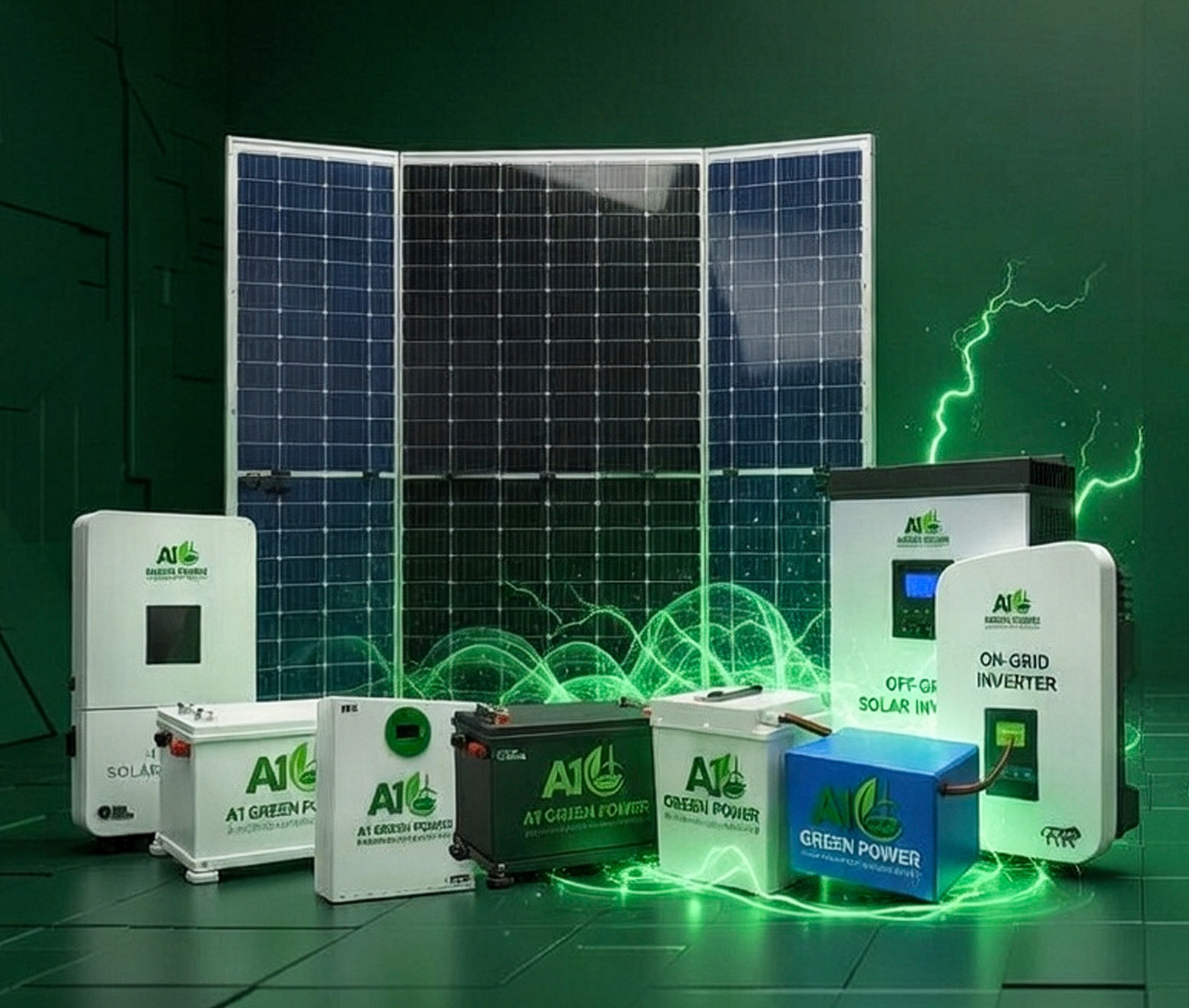
What strikes me about A1 Green Powers is that they’re not just a solar panel shop that decided to put their name on imported hardware. They actually manufacture. Solar PV modules, lithium batteries, inverters, EV chargers — this is a full production operation, not a rebranding exercise.
That matters for a very practical reason. When something needs attention — a warranty claim, a technical query, a service visit — you’re dealing with the people who built the thing. That changes the dynamic entirely.
Their Solar Panel Range Is Built Around TOPCon Technology
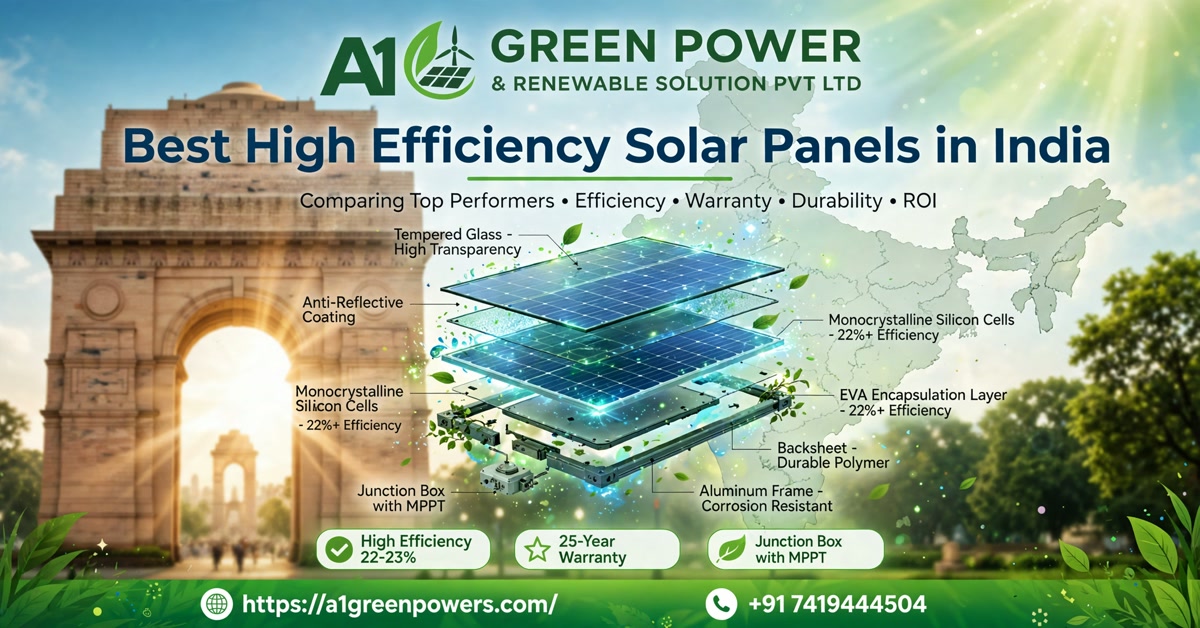
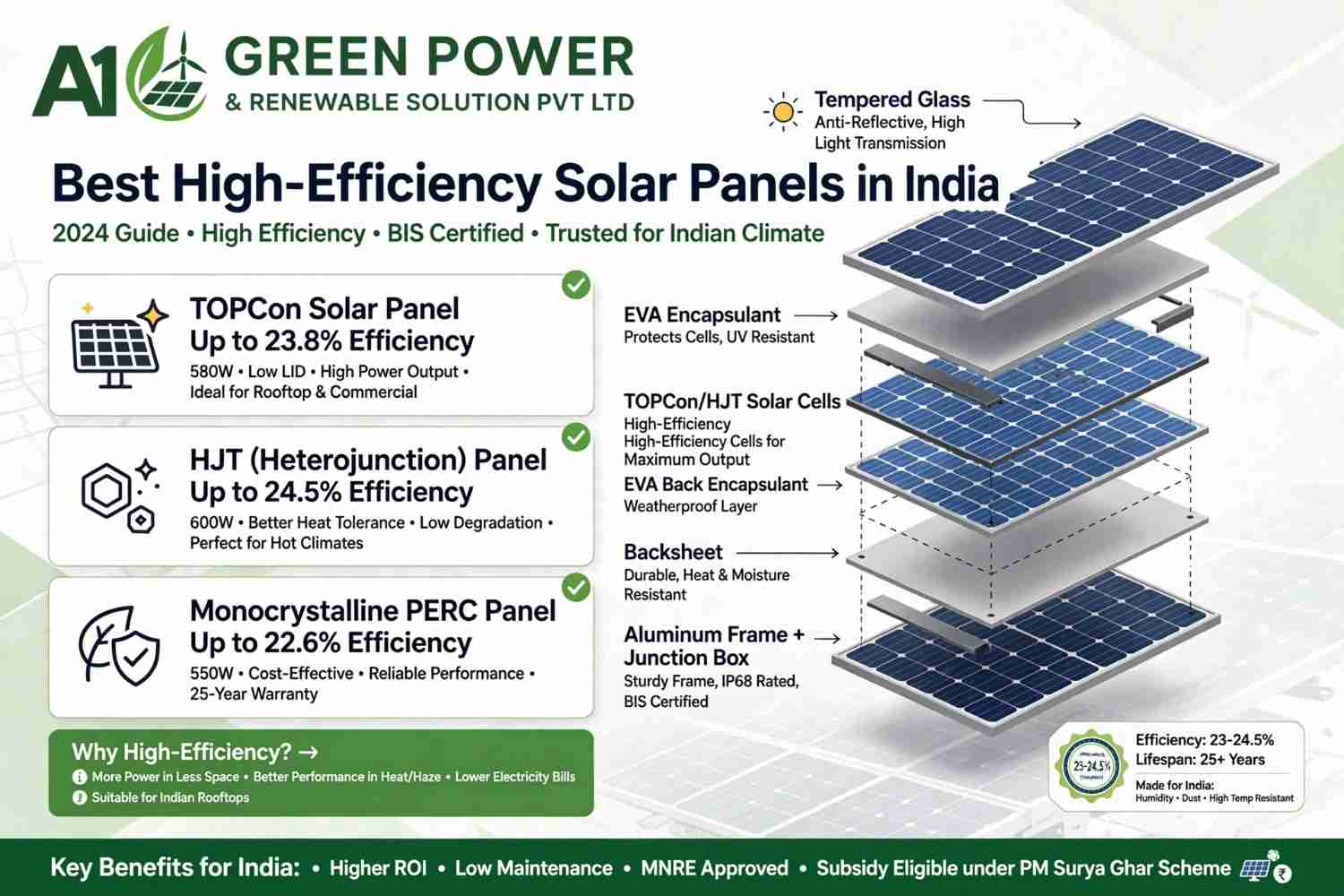
If you’ve been paying any attention to the solar industry in 2026, you’ll know that TOPCon is the technology everyone is talking about. TOPCon stands for Tunnel Oxide Passivated Contact. It’s a newer generation of panel design that delivers meaningfully better efficiency than the PERC panels that dominated the market just a few years ago.
I’ll skip the physics lesson and get to what actually matters for buyers.
TOPCon panels generate more electricity from the same roof space. They hold up better on hot Indian afternoons — their temperature performance is genuinely superior. And in places like Punjab, Haryana, and parts of UP where winter fog can last for weeks, TOPCon panels continue pulling in energy when PERC panels sitting next to them are underperforming. The degradation rate is also lower, which means the gap between what you were promised and what you actually get stays narrow over 25 years.
A1 Green Powers has oriented their entire solar product line around this technology. Their current range covers:
500W Mono TOPCon Solar Panel — This is their primary residential offering. Solid choice for most home rooftop systems in the 3–5 kW range. Performs well across Indian climate zones.
570W Glass Backsheet Panel — A step up for buyers who need a bit more output per panel. Popular with mid-sized commercial buyers — clinics, small offices, retail spaces.
610W Glass-to-Glass Solar Panel — Tougher build, higher output. Glass-to-glass construction handles mechanical stress and moisture better over long periods. Common in commercial building installations.
690W Bifacial Solar Module — This is their flagship for industrial and utility-scale buyers. Bifacial panels capture sunlight from both sides. On the right surface — a white rooftop, a ground mount with reflective material underneath — they can deliver 20 to 30 percent more output than a standard monofacial panel. That’s a significant number when you’re running a factory and every unit of electricity carries a cost.
The Certifications Are All There
BIS certified. ALMM listed. IEC certified. A1 Green Powers holds the full stack, and that means buyers can claim central government subsidies under the PM-Surya Ghar Muft Bijli Yojana. For residential buyers especially, that subsidy can run into tens of thousands of rupees — so the certification question is very much a financial one, not just a technical checkbox.
How A1 Green Powers Stacks Up Against the Bigger Names
I want to be fair here. Companies like Waaree Energies, Tata Power Solar, and Adani Solar are legitimate operations with serious scale. Waaree, for instance, has 12 GW of annual production capacity. Tata Power Solar carries the trust equity that comes with being part of the Tata Group. These are not pretenders.
But scale and trust aren’t the same thing as fit for purpose.
Here’s a pattern I see repeatedly. The large legacy manufacturers are increasingly focused on utility-scale contracts — massive government projects, industrial parks, big EPC deals. The residential and small commercial buyer often ends up getting routed through multiple dealer tiers. Your warranty claim lands with a dealer who has to escalate it to a distributor who has to escalate it to the company. That chain introduces delay and diffusion of responsibility.
A1 Green Powers is at a different point in their growth curve. They’re still manufacturer-direct in the way that actually matters for smaller buyers. If you call them with a problem, you’re talking to the people who can actually do something about it. That doesn’t last forever as companies grow, but right now it’s a genuine differentiator.
For homeowners and small-to-mid commercial buyers — the 5 kW rooftop family, the 50 kW factory shed owner, the school or hospital looking at a 100 kW system — A1 Green Powers is worth taking seriously alongside the bigger names. Not instead of them necessarily, but alongside them, with clear eyes about what each option actually delivers.
A1 Green Powers Beyond Solar Panels: The Bigger Picture
One thing I appreciate about A1 Green Powers is that they’re not a one-product company. If you’re thinking seriously about energy independence, solar panels alone don’t get you there. You need storage. You need an inverter that works well with your setup. Ideally, you want all of this from a single source you can hold accountable.
A1 Green Powers manufactures:
Lithium LiFePO4 Batteries — for home and commercial energy storage. LiFePO4 chemistry is the right choice for Indian conditions. More stable than other lithium types, better cycle life, safer in high-temperature environments.
Solar Inverters — on-grid, off-grid, and hybrid configurations. Having your panels and inverter from the same manufacturer simplifies the compatibility question significantly.
EV Chargers — both for home use and commercial charging stations.
E-Vehicle Batteries — for e-rickshaws, e-scooters, e-loaders, and e-cycles. This is a product category that matters enormously in smaller Indian cities and towns where commercial electric vehicles are increasingly common.
The fact that all of this comes out of one manufacturing facility in Haryana means there’s real accountability running through the whole ecosystem.
Practical Guide: Picking the Right Solar Panel Without Getting Misled
I’ve watched too many buyers get sold on the wrong product — either because they focused only on price, or because they trusted a slick pitch without asking the right questions. Here’s a no-nonsense framework for making a smart decision.
Start With Your Own Consumption Numbers
Pull out your last three electricity bills. Calculate your average monthly consumption in units. If you’re using 250 to 350 units a month as a household, a 3 kW system will likely cover most of your needs. Above 400 units, look at 5 kW or higher. For commercial buyers, the calculation gets more nuanced — daily load profiles matter, not just monthly totals.
Technology Choice in 2026 Is Simple: Go TOPCon
I won’t spend too long on this because the answer is straightforward. TOPCon outperforms PERC in efficiency, low-light conditions, and long-term output retention. The price difference has narrowed considerably in the past two years. If someone is offering you PERC panels at a significantly lower price and presenting it as a deal, factor in the lower lifetime output before you celebrate.
Ask for Documents Before You Decide Anything
This is where buyers lose money. They trust verbal assurances. Before you commit to any solar panel purchase, ask the supplier for the BIS certificate number (verify it on the BIS website), the ALMM listing entry for the specific panel model, and the IEC test report.
If the supplier hesitates, stalls, or gives you vague answers — walk away. A legitimate manufacturer has these documents and will share them without drama.
The Warranty Question Is Deeper Than It Looks
A 30-year performance warranty sounds impressive. But the real question is who is actually backing it. Is it the manufacturer? Is it a dealer who may not exist in five years? Can you reach them? Do they have a service team in India?
With A1 Green Powers, the manufacturer is the warranty provider. Their facility is in Haryana. They’re reachable. That’s the standard you should hold every solar supplier to.
Think in Rupees Per Unit Over 25 Years, Not Rupees Per Watt Today
Cheap panels that degrade to 75% output by Year 10 will cost you more over their lifetime than quality panels that hold 90% output through Year 25. This isn’t a complicated calculation, but almost no one does it. If you want help running the numbers for your specific situation, a company like A1 Green Powers can help you model it before you buy.
Conclusion
Buying solar in India in 2026 is not as simple as picking the cheapest option or the most advertised brand. The market is messy. The stakes are high. And the decisions you make today will follow you for the next quarter century.
What I look for — and what I’d tell any friend or client to look for — is a combination of genuine manufacturing, proper certifications, honest product performance, and real accountability on warranties.
A1 Green Powers ticks those boxes. They’re not the largest company in India’s solar space, and they’ll be the first to tell you that. But for buyers who want a best solar panel from an Indian manufacturer that actually stands behind its work — a company that earns its place in any honest list of India’s top 3 solar company picks — they’re worth a serious look.
Head over to a1greenpowers.com, explore their product range, and speak with their team. Tell them your monthly consumption, your roof size, and your budget. They’ll give you a straight answer on what fits — and what doesn’t.
That’s the kind of solar panel company worth doing business with.
Frequently Asked Questions
Is A1 Green Powers a manufacturer or just a reseller?
A1 Green Powers is a genuine manufacturer. They produce solar PV modules, lithium batteries, inverters, and EV chargers at their own facility in the Kundli Industrial Area, Sonipat, Haryana. They are not a rebranding operation or an importer.
Can I get a government subsidy if I buy A1 Green Powers panels?
Yes. A1 Green Powers panels are BIS certified and ALMM listed, which are the two requirements for subsidy eligibility under India’s PM-Surya Ghar Muft Bijli Yojana scheme. You will need to work with a registered installer to complete the subsidy application process.
What exactly is TOPCon and how is it different from regular panels?
TOPCon is a newer solar cell architecture that outperforms older PERC technology in three key ways: it achieves higher efficiency (typically 21 to 23 percent), it performs better in low-light and foggy conditions, and it degrades more slowly over 25 years. In practical terms, a TOPCon panel generates more electricity from the same roof space across its entire lifetime. A1 Green Powers’ product line is built entirely around TOPCon.
What panel sizes does A1 Green Powers offer?
Their current range runs from 500W Mono panels suited for residential rooftops, through 570W and 610W options for commercial buildings, up to 690W bifacial modules for factories and industrial installations.
Do A1 Green Powers panels come with a real warranty?
They offer a 30-year linear performance warranty and a 10-year product workmanship warranty. The warranty is backed directly by the manufacturer — not through a chain of dealers — which makes it meaningfully more reliable than what many competitors offer.
How do I get in touch with A1 Green Powers?
Visit a1greenpowers.com and fill out the enquiry or quote request form. You can also reach their sales team directly through the contact information listed on the site. They’re responsive and will typically follow up the same day.
Why should I prefer an Indian manufacturer over a cheaper imported panel?
Three reasons. First, after-sales service is accessible — a service team in Haryana is easier to reach than a company in another country. Second, Indian manufacturers understand Indian grid conditions, climate zones, and subsidy requirements in a way overseas brands don’t. Third, many government subsidy schemes require domestically manufactured panels. Over a 25-year period, these factors have a real financial impact, not just a patriotic one.
What if I need more than just solar panels — inverters and batteries too?
A1 Green Powers covers the full system. They manufacture on-grid, off-grid, and hybrid solar inverters, lithium LiFePO4 batteries for home and commercial storage, and EV chargers. Getting your complete system from one manufacturer simplifies compatibility, warranty management, and technical support significantly.
How do I know if the certifications a solar company claims are real?
Ask for the specific certificate number and verify it directly on the BIS India website. For ALMM listing, check the Ministry of New and Renewable Energy (MNRE) portal. Legitimate manufacturers will give you these numbers without hesitation.
What’s the honest payback period for solar in India in 2026?
For most residential buyers, payback runs between 4 and 6 years depending on your state’s electricity tariff, how much sunlight your location gets, and what subsidy you receive. Commercial buyers often see payback in 3 to 5 years due to higher electricity costs and larger systems. After that, you’re generating essentially free electricity for the remaining 20+ years. The quality of your panels directly affects how well that math holds up over time.





Leave A Comment