

Sharma ji doesn’t talk about his solar panels anymore.
Two years ago, he wouldn’t shut up about them. Big installation. Big brand name. He’d corner you at the gate to show the app with the generation graph. Then the numbers started sagging. Then the installer stopped picking up the phone. Then someone told him his “premium latest technology” panels were actually last-generation stock sold at this-generation prices. Now when solar comes up at RWA meetings, he just stares into his chai and says, “research kar lena beta.” Do your research, son.
He’s not wrong. He’s just two years and three lakhs too late.
So. You’re googling the best high-efficiency solar panels in India. Good. That already puts you ahead of Sharma ji, who bought his panels the way most people buy phones, walked in, believed the salesman, walked out poorer. Solar rewards the people who ask annoying questions upfront. This guide is me handing you the annoying questions.
Fair warning: I’m going to tell you things the solar industry would prefer you didn’t know. Like the fact that the panel brand matters less than the installer. Like the fact that some “high-efficiency” claims are technically true and practically meaningless on your roof. Like the fact that the subsidy everyone complains about is actually claimable if your installer isn’t lazy.
Let’s get into it. Sharma ji’s chai is getting cold.
“High-Efficiency” Sounds Fancy. What Is It, Actually?
Solar brochures read like they’re written for engineers. “22.8% module efficiency!” “Advanced N-type TOPCon architecture!” Cool. What does that mean for the roof above your bedroom? Let me translate.
The Only Definition You Need
Efficiency = how much sunlight hitting the panel becomes electricity instead of just heat.
20% efficient panel. 20% becomes power. 80% becomes a very expensive sunbathing session. Higher number, more power, same roof. Done. That’s the entire concept, and honestly, that’s all most buyers need to grasp.
Why should you care? Because your roof is not infinite. Let’s be real about Indian rooftops. Water tank. Dish antenna. Clotheslines. Your mother’s tulsi plant, which is legally (morally, spiritually) immovable. That mysterious locked room nobody opens. The actual usable, shade-free area? Way smaller than you think. Higher efficiency crams more electricity into that small patch. On a tight urban roof, jumping from 19% to 22% efficiency can mean hundreds of extra units every year. That’s not a spec sheet flex. That’s money.
The Spec Nobody Brags About (But Should)
Panels hate heat. Yes, the irony of solar panels disliking heat is not lost on me either.
Here’s what happens. Summer afternoon. Your rooftop is basically a frying pan. The panel’s internal temperature shoots past 65 degrees. And for every degree above 25, output drops. A panel with a bad temperature coefficient can quietly lose 10-15% of its power right when the sun is at its strongest. You’re getting punished at peak production hours. Fun.
So when you’re comparing the best high-efficiency solar panels in India, ask for TWO numbers: efficiency AND temperature coefficient. The second one tells you whether the panel was designed for actual Indian summers or for a pleasant rooftop in Germany. Salespeople will happily talk about the first number all day. Watch their face when you ask about the second. That reaction tells you everything.
The Slow Bleed: Degradation
Every panel degrades. Every single one. The honest question is how fast.
Good panels lose about 0.4-0.5% capacity per year. Cheap ones can lose double that. Sounds tiny, right? Compound it over 25 years. The good panel is still humming at 90%. The cheap one is wheezing at 78-80%. That gap represents thousands of units of electricity you paid for but never got.
Two warranties exist, and people confuse them constantly. Product warranty covers manufacturing defects. Performance warranty guarantees output levels over time. The second one is what protects your wallet. Read it. Actually read it. I know it’s boring. Read it anyway.
Panel Types in 2026: Cutting Through the Noise
The solar market right now feels like a phone shop. Twelve options, everyone shouting “latest technology,” half of them already outdated. Here’s my honest breakdown.
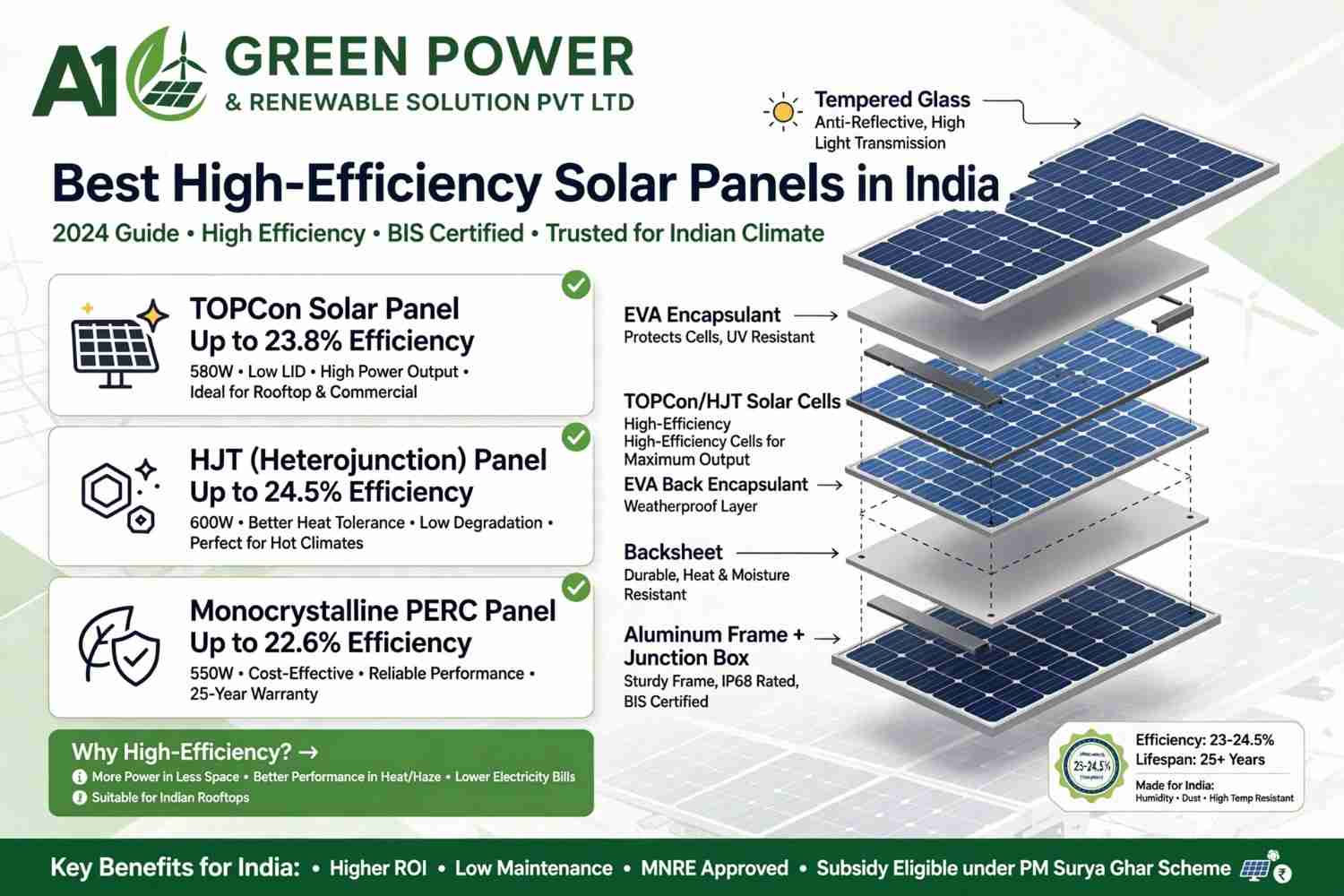
Mono PERC: The Uncle Everyone Trusts
Mono PERC has been around forever. Proven. Available everywhere. Decent prices. Efficiency around 19-21%. It’s the reliable family car of solar panels. Not exciting. Gets the job done.
But. Buying Mono PERC in 2026 is like buying a 4G phone today. Works perfectly fine. You’ll just spend the next decade watching everyone else get more from the same roof space while you… don’t. If your budget is genuinely tight and your roof is generous, fine. Otherwise, keep reading.
TOPCon: Where I’d Put My Own Money
TOPCon. Don’t worry about what it stands for (nobody at a dinner party needs to know). What matters: 21-23% efficiency, handles heat better, degrades slower. And the price gap with older tech has basically collapsed as factories scaled up.
This is the sweet spot for most Indian homes right now. The performance jump is real, the premium is small, and you’ll feel the difference every single month on your generation numbers. If Sharma ji had bought TOPCon instead of dusty old PERC stock at inflated prices, he’d still be showing people his app at the gate. Think about that.
HJT: Impressive. Expensive. Usually Overkill.
Heterojunction panels. 23%+ efficiency. Fantastic heat tolerance. Genuinely cutting-edge stuff. Also genuinely pricey.
Who’s it for? Commercial setups where roof space is gold. Homes with tiny roofs where every single watt matters. For the average 3BHK rooftop? The math usually doesn’t justify the premium. It’s like buying a sports car for grocery runs. Technically superior. Practically unnecessary. Know which one you are before you fall in love with the spec sheet.
Bifacial: Cool Idea, Check Your Roof First
Bifacial panels catch light from both sides, including reflection off the surface below. On a bright white elevated rooftop? Lovely bonus generation. On a typical Indian roof with parapet walls, water tanks, and general chaos? The back side mostly sees shadows and pigeon nests.
Don’t pay extra for bifacial unless your specific installation can actually use it. Ask the installer to show you the expected back-side gain for YOUR roof geometry. If they can’t, they’re selling you a feature, not a benefit.
Money. Let’s Do the Uncomfortable Math.
Everyone loves the idea of solar. Nobody loves doing the arithmetic. Too bad. The arithmetic is where the truth lives.
What You’ll Actually Pay
Ballpark for India right now: ₹60,000-80,000 per kW before subsidy. A 3 kW system, the sweet spot for many urban homes, lands around ₹1.8-2.4 lakh before subsidy. Panel tech, inverter brand, structure quality, and your city all move this around.
But stop thinking in sticker price. Start thinking in cost-per-unit over 25 years. Solar electricity typically works out to ₹2-3 per unit across the system’s life. Your discom charges ₹7-10 per unit in most states, and that number only moves one direction. Up. Every year. Forever. THAT’s the comparison that matters, and it’s not even close.
The Subsidy Nobody Believes Is Real (It Is)
PM Surya Ghar Muft Bijli Yojana. Central assistance up to ₹78,000 for a 3 kW system. Real money. Real scheme. Thousands of households have received it.
So why does everyone act like it’s a myth? Because the process involves a government portal, discom coordination, and net-metering approval. Bureaucracy. People see paperwork and their soul leaves their body.
Here’s the secret: a competent installer does all of this for you. It’s literally part of the job. If your installer says the subsidy is “too complicated” or “takes too long,” translate that correctly: I don’t want to do the paperwork. That’s not a subsidy problem. That’s a you-need-a-better-installer problem.
Payback: The Honest Version
With subsidy, a typical 3 kW system pays for itself in 4-6 years in states with reasonable tariffs. Then you’ve got ~20 years of nearly free electricity. Total savings over the system’s life? Lakhs. Plural.
But, and this is a big but, anyone quoting you a payback period without studying your last 12 months of electricity bills is performing, not calculating. Your tariff slab, your usage pattern, your roof’s actual sun exposure, these decide YOUR payback, not some national average. Demand a personalised calculation. It’s your money. Act like it.
The Costs Hiding in the Cheap Quote
That suspiciously low quote? Let me tell you what’s probably hiding inside. A flimsy mounting structure that’ll groan in the first real monsoon wind. A bargain-bin inverter, which is the one component almost guaranteed to need replacing around year 10-12. Zero after-sales support, which you’ll discover the first time generation dips and nobody answers.
The cheapest quote in solar is like the cheapest parachute. Technically it exists. Do you really want it?
The Uncomfortable Truth: Your Installer Matters More Than Your Panels
I’m going to say the thing that makes panel manufacturers nervous.
For residential buyers, WHO installs your system matters more than WHICH panels you buy.
Same panels. Same roof design. Two different installers. Wildly different generation numbers. Why? Panel tilt angle. Orientation precision. Shadow analysis (or the lack of it). Wiring quality. Whether the inverter is correctly sized or just whatever was in the warehouse. These boring details decide everything.
Sharma ji’s panels weren’t garbage. His installation was mediocre and his after-sales was fictional. The panels take the blame in his story, but the installer wrote the tragedy. Don’t be Sharma ji.
Vetting an Installer Like Your Money Depends On It (It Does)
MNRE empanelment or equivalent. Non-negotiable starting point.
Installations in YOUR city, not just total numbers. Someone with 500 installs in Gujarat tells you nothing about monsoon performance in Kerala.
Three references. Call them. Actually call them. Ask: did generation match promises? When something went wrong, how fast did they respond? Would you hire them again? That last question is the killer. Listen to the pause before the answer.
Ask about their shadow analysis process. If they look confused, leave. If they pull out proper assessment tools, stay.
Visit an old installation. A two-year-old system tells you more than any sales presentation ever will. How’s it holding up? How’s the structure? How’s the generation?
Red Flags. Memorise These.
Quote way below everyone else. Pressure to sign NOW, offer expiring TODAY. Vague about subsidy handling. No physical office you can visit. Won’t put commitments in writing. Gets uncomfortable when you mention your own technical advisor.
The solar industry has brilliant professionals and complete chancers, sometimes operating on the same street. The chancers all use the same script. Learn it, and you’ll never fall for it.
How We Do It at A1 Green Powers
You’ve made it this far, so here’s the straight version of how we operate. No gloss.
A1 Green Powers doesn’t start with a sales pitch. We start on your roof. Actual visit. Actual measurements. Actual shade analysis through the day. We read your electricity bills, all twelve months, and THEN recommend a system size. The right size, not the biggest size. Those are different things, and the difference shows up in your payback period.
We install current-generation high-efficiency solar panels, TOPCon and above, because putting 2026 money into outdated tech would be malpractice. Inverter, structure, wiring, everything specified to match, because we’ve seen too many systems where the panels were excellent and everything holding them up was… not.
Subsidy paperwork, net-metering approvals, discom coordination: we handle it. All of it. You shouldn’t need a degree in bureaucracy to claim money the government wants to give you.
And after commissioning, we stick around. Generation monitoring. Maintenance guidance. An actual human who picks up when something looks off. The relationship starts at installation, it doesn’t end there. That’s how it should work everywhere. It doesn’t. It does here.
If you’re seriously evaluating solar panels in India for your home or business, start with a site assessment. Free. Thorough. More useful in one hour than a month of YouTube research. Get in touch through a1greenpowers.com and let’s take a proper look at your roof.
Questions I Get Asked Constantly
How much roof do I actually need?
About 100 sq ft per kW. So 3 kW needs roughly 300 sq ft of clean, shade-free space. Higher efficiency panels squeeze the same power into slightly less area, which is precisely why efficiency isn’t just a bragging number on constrained city roofs.
What about monsoon? Do panels just… stop?
They slow down, they don’t stop. Panels run on daylight, not just direct blazing sun. Monsoon months will show lower generation, and any honest estimate bakes that in. Judge the year, not the week. Anyone showing you only sunny-month projections is cherry-picking.
Power cut? Do my panels keep running?
Standard on-grid systems shut down during outages. Safety regulation, non-negotiable. If backup matters to you, and in many Indian cities it absolutely does, ask about hybrid systems with batteries. Costs more upfront. Worth every rupee the first time the grid dies at 2 PM in May.
How long will this thing actually last?
Panels: 25-year performance warranties are standard, and many keep producing beyond that. Inverters: expect one replacement around year 10-12. Budget for it mentally now so it’s not a shock later. Structures: a good galvanised structure outlives the panels.
Is the subsidy real or is it one of those schemes nobody actually gets?
Real. People are receiving it. The process is bureaucratic but navigable, and your installer should be navigating it for you. If they’re not, that’s a review of the installer, not the scheme.
Maintenance? Be honest.
Dust off the panels occasionally, more often if you’re in a dusty city. Keep an eye on the inverter display. Get wiring checked periodically. Total annual effort: a few hours. Your car demands more attention than your solar plant. Let that sink in.
Last Thing Before You Go
Solar in India has crossed the line from “interesting idea” to “obvious decision,” at least for anyone with a suitable roof and a painful electricity bill. The tech works. The economics work. The subsidy works. The sun, last I checked, continues to show up for work every single day without fail.
The only variable is you. Specifically, whether you do the homework or pull a Sharma ji.
Current-generation high-efficiency panels. An installer you’d trust with your house keys. A system sized to your actual life, not someone’s sales target. Subsidy claimed, not abandoned. That’s the whole formula. Not complicated. Just requires slowing down for two weeks before spending two lakhs.
Your discom bill is going up next year. And the year after. That’s the single most predictable thing in this entire story. The question was never whether solar makes sense. It’s whether you’ll be the person generating their own power in five years, or the person still forwarding angry messages about tariff hikes in the RWA group.
Don’t be the second person. And definitely don’t be Sharma ji.








Leave A Comment