

Introduction
Last Tuesday, a gentleman from Dwarka called us about the best high-efficiency solar panels in India—and within five minutes, I could tell he’d been lied to twice already that week.
Let’s call him Ramesh. Fifty-two, government job, 3BHK, one AC running all night in summer. May bill: ₹8,340. He’d collected two quotes. One dealer in Karol Bagh said ₹3.2 lakh for 3 kW—”German technology, sir, fully imported.” Another said ₹1.1 lakh—”same thing, sir, don’t waste money.” Both sounded confident. Both couldn’t be right.
“Beta,” Ramesh said—I’m 38, but every uncle calls me beta—”just tell me honestly. Which panel is actually good?”
So here’s the honest version. The one I’d give you if we were sitting on your terrace with two cutting chais and no salesman in earshot.
A high-efficiency panel isn’t a luxury anymore. On a normal Indian rooftop—limited space, brutal sun, dust everywhere—efficiency is the whole game. A 23% panel versus a 19% panel doesn’t sound like much. Over 25 years, on the same patch of terrace, it’s the difference between a system that pays for itself in four years and one that limps along for seven.
This guide covers the best high-efficiency solar panels in India you can actually buy in 2026. Real technologies, real prices, the real subsidy—and every trick I’ve watched dealers pull, so nobody pulls one on you.
What “High Efficiency” Really Means (And Why Dealers Love Confusing You)
Forget the physics lecture. Here’s the one-line version.
Efficiency = how much sunlight becomes electricity. A 20% panel converts one-fifth. The rest becomes heat. Done. That’s the entire concept—everything else is salesmen adding masala.
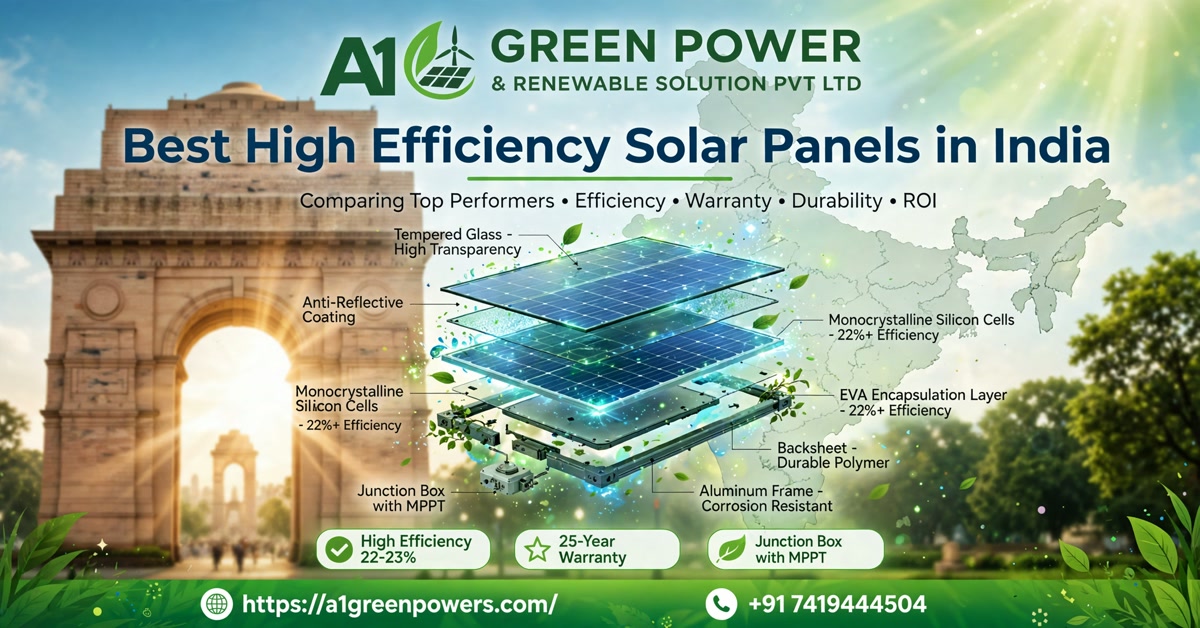
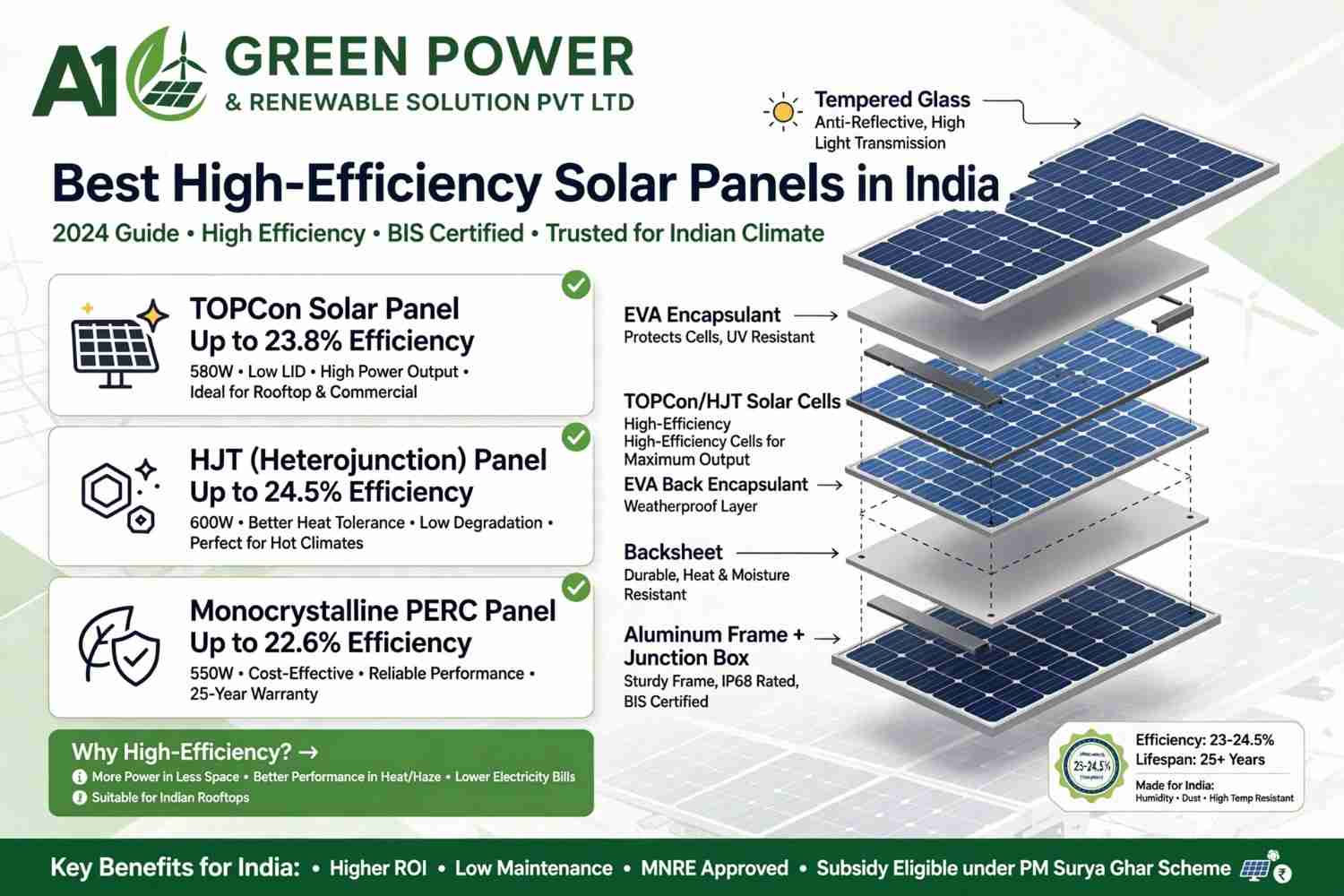
Ten years ago, most Indian homes got polycrystalline panels at 15–17%. They worked. They were also space-hungry monsters. Today’s mono panels do 20–22%, and the new TOPCon and HJT panels touch 22–24%.
Sounds like a small jump? On a 100 sq. ft. terrace, it’s an extra 500–800 watts. That’s your fans, your fridge, and every light in the house—running free, every single day, for 25 years. Small percentages, ridiculous compounding. And that compounding is exactly why anyone hunting for the best high-efficiency solar panels in India should think in decades, not months.
Your terrace in June is a furnace. Cheap panels melt in it.
Here’s what no brochure mentions: panels hate heat. Every degree above 25°C, a panel loses power. Cheap ones lose roughly 0.40% per degree. Good ones lose roughly 0.30%.
I’ve personally measured panel surfaces at 68°C on a Najafgarh rooftop in June. Sixty-eight. At that temperature, a cheap panel quietly surrenders 15–17% of its output—exactly in the months your AC is screaming for power.
That’s the real reason efficiency matters in India more than anywhere else. It’s not about bragging rights. It’s about a panel that still performs when your terrace could fry an egg. When someone asks me about the best high efficiency solar panels in India, I don’t start with brands. I ask: which city, how hot, how much shade. Everything flows from that.
Best High Efficiency Solar Panels in India: Four Technologies, Zero Commission
I don’t get a cut from any manufacturer. So here’s the straight ranking, no diplomacy.
Mono PERC—the Maruti 800 of solar panels
Not fancy. Not new. Just everywhere, and for good reason. 20–22% efficiency, the lowest price in the high-efficiency club, and lakhs of installations running fine across India for years.
If your budget is tight and your roof is decent-sized, PERC is still an honest buy. Nobody ever regretted it badly. It’s just no longer the best value—keep reading.
TOPCon—my default answer in 2026
TOPCon (Tunnel Oxide Passivated Contact, if you want to impress relatives at weddings) does 22–23.5%, handles heat and hazy winter light better than PERC, and—this is the important part—prices have crashed to nearly PERC levels as Indian factories scale up.
Nine out of ten homes we survey this year get TOPCon. When people press me to name the best high-efficiency solar panels in India for the money, I barely finish my chai before answering: TOPCon. Done. Next question.
HJT and bifacial—the premium league
HJT panels hit 23–25% with superb heat tolerance. Bifacial panels drink light from both faces—brilliant on white-painted terraces or commercial ground mounts.
The catch is price, obviously. These make sense when your roof is tiny but your consumption is huge—villas, factories, farmhouses with fat bills, and small terraces. Every extra unit has real commercial value there, so the premium pays back. For a normal 3BHK? Overkill. Don’t let anyone upsell you.
Polycrystalline—dead. Don’t let anyone sell you a corpse.
Poly panels are 2026’s biggest dealer scam. Cheaper upfront, sure—and they guzzle space, perform terribly in heat, and the technology is basically discontinued. If a dealer pushes poly panels today, he’s clearing dead stock from his godown. Smile, say thank you, and walk out.
How to Choose Without Getting Fooled
Step one: measure your roof. Not the brochure—your roof.
A 1 kW system needs roughly 80–100 sq. ft. of shadow-free space. Most city homes fit 2–5 kW.
My rule, honed over hundreds of site visits: small roof → buy the highest efficiency you can afford, because every square foot has to earn its keep. Big roof → a slightly cheaper panel can win on payback. Roof first, panel second. Anyone who quotes you a system without measuring your terrace is gambling with your money, not his.
Step two: ALMM or it didn’t happen.
The government’s Approved List of Models and Manufacturers (ALMM) is the list of panels approved for subsidy projects. No ALMM panel = no PM Surya Ghar subsidy. Full stop.
Ask your vendor to show the ALMM listing in writing. A genuine installer pulls it up without blinking. One who changes the topic—”same quality, sir, just not on the list”—has told you everything you need to know about him. Believe him.
Step three: read the warranty. Actually read it.
Two warranties, and dealers love quoting only the pretty one. Product warranty (10–15 years) covers manufacturing defects. Performance warranty (25–30 years) promises output—usually 90% for the first 10 years, 80% till year 25.
Read the degradation line, not the headline. Then ask the awkward question: who honors this—a company with service centers in India, or a name you’ll never find again? A shorter warranty from a reachable company beats a longer one from a ghost. This one habit—reading before signing—separates happy owners of the best high-efficiency solar panels in India from the ones writing angry Google reviews at midnight.
Step four: don’t pair a racehorse with a bullock cart.
That’s what a great panel with a cheap inverter is. For most homes, a solid string inverter from an established brand is plenty. But if your roof has partial shade—the neighbor’s water tank, a parapet wall, that one stubborn tree—spend extra on micro-inverters or optimizers. They stop one shaded panel from dragging the entire system down like the weakest kid in a tug-of-war.
Picking the best high-efficiency solar panels in India and then strangling them with a bargain-bin inverter is the most expensive mistake on this list. Don’t.
The Money Part: Prices, Subsidy, and Payback
What you’ll actually pay per kW
Straight numbers, 2026, no games: a proper residential rooftop system costs ₹55,000–₹80,000 per kW before subsidy. Panel tech, inverter brand, structure quality, and your city—all of it moves the needle.
A 3 kW system, the sweet spot for most families, lands around ₹1.8–₹2.4 lakh all-in. TOPCon sits at the higher end. Worth it—the payback math below will show you why.
Now, about Ramesh’s two quotes. ₹3.2 lakh for 3 kW? Robbery with a smile and a “German technology” story. ₹1.1 lakh? Also a trap—at that price they’re cutting the mounting structure (which has to survive 150 km/h winds, by the way), the DC wiring, or the after-sales service. We’ve ripped out “bargain” systems that died in three years. Tattoo this on your brain: the cheapest quote is almost never the cheapest system.
The subsidy is real money. Here’s exactly how much.
Under the PM Surya Ghar: Muft Bijli Yojana (MNRE’s scheme, running strong in 2026): ₹30,000 for 1 kW. ₹60,000 for 2 kW. ₹78,000 for 3 kW and above — capped there, so even a 5 kW system gets ₹78,000.
It lands directly in your bank account after installation and DISCOM inspection, usually within 30–45 days. Not a coupon. Not a discount voucher. Cash. Plus up to 300 free units a month for a typical household.
And some states stack their own money on top — Delhi announced a matching ₹78,000 state grant in September 2026, which means ₹1.56 lakh total if you’re in the capital. Check your state’s policy before locking numbers. Two conditions, both non-negotiable: ALMM-listed panels, registered vendor. Your installer should handle the entire application himself. If he says “subsidy aap khud apply kar lena” — find another installer.
Payback, using Ramesh’s numbers
3 kW at ₹2.1 lakh. Minus ₹78,000 subsidy. Net out of pocket: roughly ₹1.32 lakh.
A 3 kW system in North India generates about 12–14 units a day. Call it 4,200 units a year. At ₹7–8 per unit, that’s ₹30,000–₹34,000 a year; you’re simply not paying the DISCOM.
Payback: around 4 years. Then 20+ years of near-free electricity.
Read that twice. This is why I keep telling people the best high-efficiency solar panels in India aren’t an expense. Show me another ₹1.3 lakh purchase that pays you back every single month for two decades while you do absolutely nothing.
Installation and Maintenance (Where Good Systems Go to Die)
The panels are only half the story. I’ve seen the best high-efficiency solar panels in India underperform for the dumbest reasons—and every single one was avoidable.
Shade: the silent killer
A panel doesn’t need full shade to suffer. A thin shadow from a dish antenna across one corner can tank a whole string’s output. And here’s what amateurs miss: the winter sun sits lower and throws longer shadows than the summer sun. So a proper survey maps shade across seasons, not just on installation day.
Never—never—let anyone install without a shadow analysis. If the “survey” is some guy glancing at your roof for 90 seconds while on a phone call, that’s not a survey. That’s a formality before a mistake.
Dust, monsoon, and pigeons. Yes, pigeons.
Dust steals 5–15% of your output in most Indian cities. The fix is insultingly simple: every 2–3 weeks, plain water, soft mop. That’s it. No chemicals, no scrubbing like you’re cleaning a tawa.
A monsoon is a mixed bag—rain washes dust but leaves a muddy film behind. One good wash after the season ends.
And pigeons… I’m completely serious. They will colonize the gap under your panels and turn it into a housing society—droppings, nests, blocked airflow, the works. Bird-proofing mesh costs around a thousand rupees and saves you endless grief. Ask for it on day one, not after the cooing starts.
Stalk your own system.
Every modern inverter comes with an app. Check it once a week. You’ll learn your system’s rhythm within a month—and you’ll catch a tripped breaker or a dusty patch weeks before it shows up as a fat electricity bill.
Trade secret: the homes with the best returns don’t have the most expensive panels. They have owners who pay attention. Five minutes a week. That’s the whole trick, and most people won’t do it.
Frequently Asked Questions
Which panel has the highest efficiency in India right now?
HJT, at 23–25%, with TOPCon right behind at 22–23.5%. But “highest” and “smartest buy” are different things—for most homes, TOPCon wins on the only metric that matters: rupees saved per rupee spent.
What does a high-efficiency system actually cost?
₹55,000–₹80,000 per kW before subsidy. After the ₹78,000 PM Surya Ghar subsidy, a typical 3 kW setup costs you about ₹1.3–₹1.6 lakh net. Anyone quoting wildly outside this band is either robbing you or cutting corners. There is no third option.
My roof is small. Are high-efficiency panels worth the premium?
This is literally the situation the best high-efficiency solar panels in India were invented for. A small roof means every square foot must produce maximum power. The premium usually pays for itself within two years through extra generation alone.
How do I actually get the PM Surya Ghar subsidy?
Apply on the official portal through a registered vendor, install ALMM-listed panels, clear the DISCOM inspection—and ₹30,000 to ₹78,000 lands in your bank account. Your installer should drive this entire process. If he won’t, that tells you all you need to know about him.
How long do these panels last?
25–30 year performance warranty, and they keep working after that. Roughly 0.5% output loss per year—so after 25 years you’re still near 87%. Your AC won’t last that long. Your fridge won’t. The panels will outlive half your appliances, and they’ll do it silently.
Do I really have to clean them?
In India? Yes. Every 2–3 weeks, water and soft mop. Skip it, and dust quietly eats 5–15% of your savings. Honestly, it’s the highest-paid five minutes of housework you’ll ever do.
Conclusion
So here’s the short version—the one I’d give Ramesh, and you, over that second chai:
Small roof, big bills? Go high-efficiency. TOPCon for the best value in 2026. HJT or bifacial only if space is desperately tight. ALMM-listed panels, a registered vendor, every rupee of subsidy claimed. Then wash them, watch the app, and let the sun do the heavy lifting for 25 years.
Ramesh, by the way? He went with a 3 kW TOPCon system. It went live in July. His August bill was ₹340—down from ₹8,340. He now checks his generation app the way the rest of us check cricket scores, and he calls me “beta” with noticeably more warmth than before.
Your terrace is sitting up there right now, catching free sunlight and doing absolutely nothing with it. That strikes me as a waste.
At A1 Green Powers, we do the survey properly, size the system honestly, handle the entire subsidy paperwork, and stay answerable for years—not just until the cheque clears. Because the best high-efficiency solar panels in India are only half the equation. The other half is the team standing on your roof.
Book your free site survey today. Let’s find out what your terrace is really worth.







Leave A Comment