


Introduction
If you’ve spent even ten minutes comparing quotes lately, you’ve probably heard the term TOPCon thrown around a lot. There’s a reason for that. A TOPCon solar module India buyer picks today isn’t just a slightly better version of the old mono-PERC panel your neighbour installed three years ago — it’s a genuinely different cell architecture, and it’s fast becoming the default choice for anyone serious about long-term generation.
Here’s why it matters. TOPCon stands for Tunnel Oxide Passivated Contact, an n-type cell design that Indian manufacturers have been racing to adopt since 2024. And frankly, India’s climate makes this a bigger deal than it sounds on paper. Rooftop panel temperatures routinely cross 60°C during peak summer, and older panels lose a chunk of their output right when you need power the most — during the day, in the heat, with the AC running.
This guide walks through what actually makes a TOPCon solar module worth the money, how it stacks up against mono-PERC and HJT, what you should expect to pay in 2026, and how to vet a manufacturer before you sign anything. We’ll also cover subsidy eligibility and answer the questions we get asked most often by homeowners and business owners across Haryana and beyond.
What Is a TOPCon Solar Module and How Does It Work?
The Technology Behind TOPCon Panels
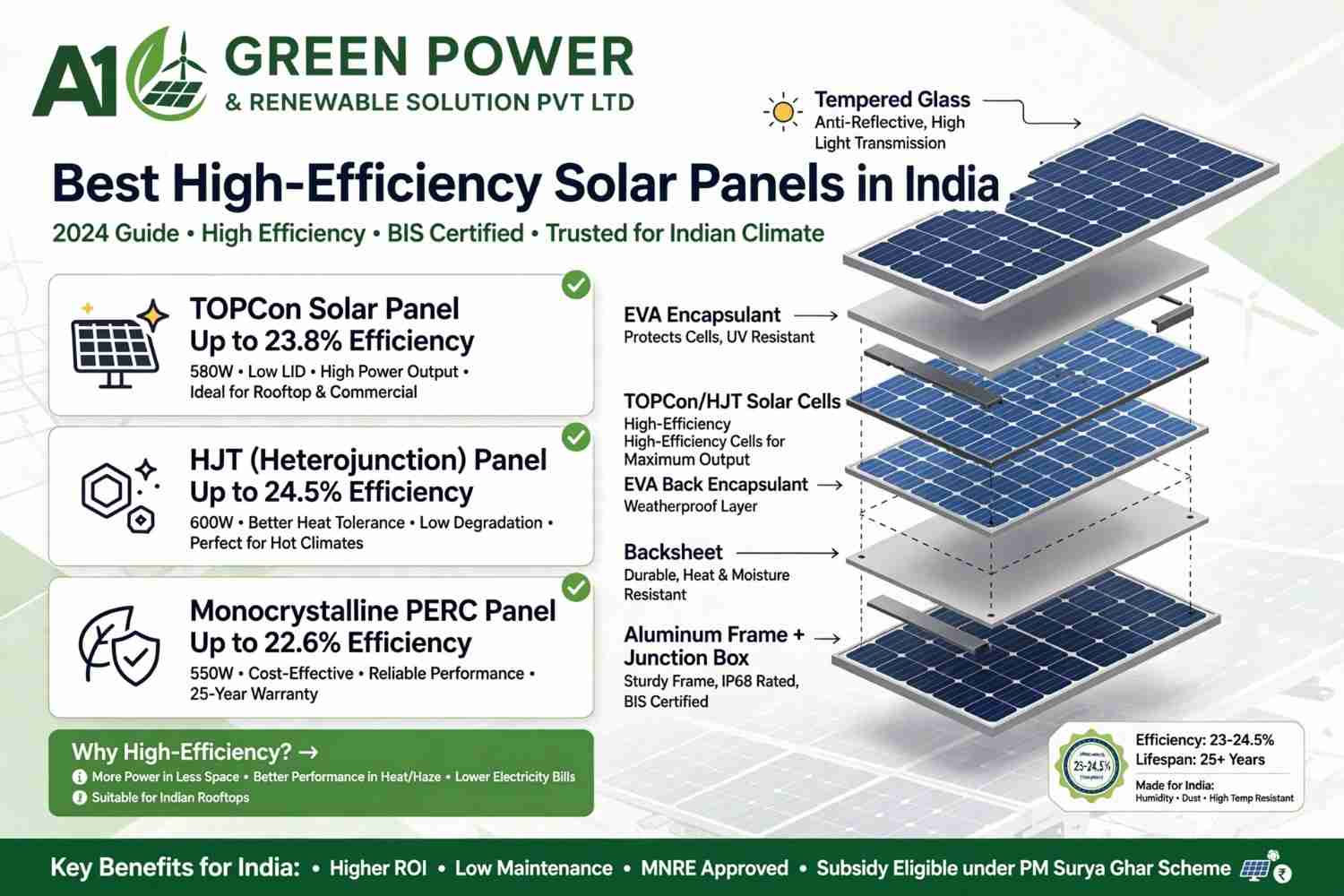
Strip away the jargon and here’s what’s actually happening: a TOPCon panel adds a whisper-thin layer of tunnel oxide, plus a doped polysilicon layer, to the back of an n-type silicon wafer. That layer cuts down on electron recombination — basically the main way older panels waste energy internally — and lets more of the sunlight hitting the panel actually turn into electricity you can use.
What does that mean in real numbers? Commercial TOPCon modules sold in India today typically land somewhere between 21% and 24% efficiency at standard test conditions. Mono-PERC panels of the same physical size usually sit at 19% to 22%. Doesn’t sound like a huge gap on paper, but multiply it across a 25-year system and it adds up fast.
Why This Matters for Indian Rooftops
Panels are rated in a lab at 25°C. Your roof in June is nowhere close to that. As cell temperature climbs, output drops — how much depends on the panel’s temperature coefficient. TOPCon modules generally sit around -0.29% to -0.32% loss per °C above the rated point, versus -0.34% to -0.37%/°C for typical mono-PERC panels. It’s not a dramatic difference on any single day, but across a Haryana or Rajasthan summer, it’s real, measurable extra generation.
TOPCon vs Mono-PERC vs HJT: How They Compare
Efficiency and Output, Side by Side
| Technology | Typical Efficiency | Temperature Coefficient | Price Tier (2026) |
|---|---|---|---|
| Mono-PERC | 19–22% | -0.34% to -0.37%/°C | Lowest |
| TOPCon | 21–24% | -0.29% to -0.32%/°C | Mid |
| HJT | 23–25% | -0.24% to -0.26%/°C | Highest |
Why Most Buyers End Up Choosing TOPCon
HJT wins on raw numbers — better efficiency, better heat tolerance. But it also carries a 12% to 18% price premium in 2026, and for most residential or commercial buyers, that premium is hard to justify. Mono-PERC is the cheapest option upfront, but it degrades faster and loses more output on hot afternoons. TOPCon sits right in the middle, and that’s exactly why it’s become the practical, default answer for most Indian rooftops: a real efficiency jump over mono-PERC, without paying HJT prices.
It’s also why SECI and NTPC tenders increasingly ask for TOPCon by name, and why manufacturers like Waaree, Adani Solar, Vikram Solar, Premier Energies, and Tata Power Solar have all poured investment into TOPCon production lines under the government’s PLI scheme.
Applications: Home, Commercial, and Industrial Use
Residential Rooftops
For homes, the appeal is straightforward — more capacity on the same roof. A 3 kW system using higher-wattage TOPCon panels needs fewer physical modules than the equivalent mono-PERC setup, which matters a lot on the smaller urban rooftops most of us actually have, with water tanks, staircases, and the neighbour’s building casting shade half the day.
Commercial and Factory Rooftops
Businesses running daytime loads get the most out of solar, full stop, because your consumption and your generation curve line up almost perfectly. Factories and warehouses installing a TOPCon solar module India setup on a large industrial shed roof can knock out a big chunk of daytime grid draw, and the better heat tolerance means output holds up during the hottest production hours — not just the mild morning ones.
Agricultural and Off-Grid Use
TOPCon also handles partial shade and low-light conditions a bit better than older panels, which helps for agricultural pumping and off-grid rural setups where structures or trees cast shadows during parts of the day.
TOPCon Solar Panel Price in India and Subsidy Eligibility
What You’ll Actually Pay in 2026
Expect DCR-compliant TOPCon modules — the ones eligible for subsidy — to run roughly ₹22 to ₹28 per watt. Non-DCR imported panels can be a bit cheaper, but they generally don’t qualify for government schemes, so the “savings” often disappear the moment you factor that in.
PM Surya Ghar and ALMM Eligibility
Under the PM Surya Ghar Muft Bijli Yojana scheme, only modules that appear on MNRE’s Approved List of Models and Manufacturers qualify for subsidy. This part trips people up: it’s not enough for the manufacturer to be listed. The exact model number on your quote has to match what’s on the MNRE ALMM portal at the time of installation, or your subsidy claim gets rejected outright. Always double-check this yourself before you sign.
A1 Green Power’s TOPCon modules are manufactured at our Sonipat, Haryana facility, BIS certified, with every single module put through EL (electroluminescence) testing before it leaves the plant.
Is TOPCon Worth the Extra Cost?
For most Indian rooftops, honestly, yes. A TOPCon system costs maybe 5% to 10% more upfront than mono-PERC, but it generates more energy per square metre and holds up better over 25 to 30 years. On a typical home or commercial system, the extra generation makes up that price difference well inside the warranty period — and it matters even more if your roof space is limited, since fewer, higher-wattage panels get you to the same target capacity.
Choosing a TOPCon Solar Module Manufacturer in India
Questions Worth Asking Before You Buy
Is the exact model ALMM-listed? Not just the brand — the specific wattage and model number you’re being quoted.
What warranty is on the table? Look for 12 to 15 years of product warranty and 25 to 30 years of linear performance warranty. Anything shorter, for a technology sold as a decades-long investment, should give you pause.
Is testing done in-house or outsourced? Ask whether EL testing, PID (potential induced degradation) testing, salt mist testing, and thermal cycling happen on-site, or if the manufacturer just relies on occasional third-party spot checks.
Where is it actually made? Panels manufactured in a facility you can verify tend to mean shorter, simpler supply chains if you ever need a warranty claim honoured.
What A1 Green Power Offers
We manufacture TOPCon solar modules at our facility in Kundli Industrial Area, Sonipat, Haryana — everything from 500W mono panels up to glass-to-glass bifacial modules in the 610W to 715W range. Every module ships with a 15-year product warranty and a 30-year linear performance warranty, backed by in-house EL testing, PID testing, and salt-mist corrosion testing. We’ve supplied solar, battery, and inverter systems to clients including Hyundai, Mahindra, Haldiram’s, Lupin, and IIT Madras.
Installation, Maintenance, and Long-Term Performance
Sizing Your System Correctly
Sizing starts with your average monthly consumption, roof orientation, and how much shadow-free area you actually have — not the biggest system a salesperson can talk you into. Because TOPCon modules pack more wattage into the same footprint, homes with tight roof space often end up fitting a larger effective system than they could with mono-PERC panels covering the same area.
Bifacial Gains on Reflective Surfaces
Glass-to-glass bifacial TOPCon panels pick up reflected light on the rear surface too. On a light-coloured rooftop, white gravel, or an elevated ground-mount structure, that bifacial gain can add another 2% to 4% of annual energy compared to a standard monofacial panel of the same rating.
Inverter and System Matching
Higher-wattage panels mean your inverter and DC cabling need to be sized properly from day one. An undersized inverter clips your peak output on bright afternoons — quietly wasting generation you already paid for. Our team checks string voltage, inverter input range, and cable sizing on every quote, so the panels, inverter, and battery (if you’re adding one) actually work together as one system instead of three mismatched parts.
Degradation Over 25–30 Years
Every panel loses a small amount of output each year — that’s normal and built into the warranty terms. TOPCon typically degrades around 0.4% to 0.5% annually, compared to roughly 0.55% to 0.7% for mono-PERC. Stretch that out over 30 years and a TOPCon system is still producing somewhere around 87–88% of its original rated output near the end of its warranty — noticeably better than what older technology delivers at that same point.
Maintenance Expectations
Day-to-day, TOPCon needs the same basic care as any crystalline-silicon panel: occasional cleaning to clear dust, a periodic check of wiring and mounts, and keeping an eye on output against what your inverter expects to generate. One nice perk — TOPCon has near-zero light-induced degradation from day one, so most owners see stable output from month one rather than the slight settling-in dip sometimes seen with older PERC panels.
Conclusion: Making the Right Choice for Your Rooftop
A TOPCon solar module India installation gives you a genuinely good balance of efficiency, heat resistance, and long-term warranty coverage — hard to match at a similar price point right now. Whether it’s a home, a factory floor, or a commercial building you’re powering, the extra wattage per panel and slower degradation add up to more units generated and a quicker path toward that zero-electricity-bill goal everyone’s chasing.
Before you commit to anything, verify the exact model’s ALMM listing yourself, ask about the manufacturer’s in-house testing, and compare warranty terms line by line — not just the wattage number on the brochure.
Ready to talk specifics? A1 Green Power manufactures BIS-certified, ALMM-eligible TOPCon solar modules right here in Sonipat, Haryana, backed by a 15-year product warranty and a 30-year linear performance warranty. Get a free quote to talk to our engineering team about sizing the right system for your roof.
Frequently Asked Questions
What is a TOPCon solar module and how is it different from mono-PERC? A TOPCon module is an n-type solar cell with a passivation layer that cuts down energy loss, delivering around 21–24% efficiency versus 19–22% for mono-PERC. It also handles heat better, so it loses less output on hot days.
Is a TOPCon solar module India buyers choose eligible for PM Surya Ghar subsidy? Yes — as long as the exact model is on the MNRE ALMM list at the time of installation. Check the specific model number, not just the brand name, before you buy.
How much does a TOPCon solar module cost in India in 2026? DCR-compliant TOPCon modules typically run ₹22 to ₹28 per watt, depending on wattage, format, and manufacturer.
What warranty should I expect on a TOPCon solar module? Reputable Indian manufacturers, A1 Green Power included, offer 15 years of product warranty and 30 years of linear performance warranty on TOPCon modules.
Does TOPCon actually perform better than mono-PERC in Indian heat? Yes. TOPCon’s temperature coefficient of around -0.29% to -0.32%/°C means it loses less output than mono-PERC’s -0.34% to -0.37%/°C as cells heat up during peak summer.
Where are A1 Green Power’s TOPCon solar modules manufactured? At our facility in Kundli Industrial Area, Sonipat, Haryana — with 100% in-house EL and PID testing on every module.






Leave A Comment