

Introduction
Your last electricity bill is probably why you’re here. Delhi’s tariffs have been climbing for a while now, and once a household crosses a certain usage threshold, the jump in cost per unit starts to sting. That’s the main reason solar panel installation in Delhi has stopped being a “someday” idea for a lot of families and turned into something people actually book this year.
Part of that shift is subsidy money. Between the central PM Surya Ghar scheme and Delhi’s own top-up, you can knock a real chunk off the sticker price — we’ll get to the exact numbers shortly. But subsidies are only half the story. Net metering rules changed in Delhi this July, DISCOM paperwork got simpler, and the panels themselves are better than what was available even two or three years ago.
So this guide is basically everything I’d want to know before getting quotes: what a system actually costs after subsidy, how the DERC net metering process works, what can go wrong with the paperwork, and how to tell a decent installer from one that’ll leave you chasing them for six months. If you’ve been putting off solar panel installation in Delhi because the process felt confusing, hopefully this clears most of it up.
Why Solar Panel Installation in Delhi Makes Sense Right Now
I won’t pretend solar is the right call for every single home — if your roof is heavily shaded or your bills are already tiny, the payback math gets less exciting. But for most Delhi households, the numbers line up well.
Electricity Isn’t Getting Cheaper
DERC’s approved base tariff for FY 2026 tops out around ₹8 per unit once you cross 800 units a month, and that’s before the PPAC surcharges that BRPL, BYPL, and TPDDL each add on top — and as of June 2026, those surcharges get revised monthly instead of quarterly, so bills move more often than they used to. If your household regularly runs air conditioning, water heaters, or just has a lot of people in it, this adds up fast. Solar doesn’t make that tariff disappear, but it does mean a big chunk of your usage stops touching the grid altogether.
The Rules Got Friendlier
A few years back, rooftop solar in Delhi meant permissions from multiple departments and a fair amount of waiting around. That’s changed. Under the current Delhi Solar Energy Policy, you don’t need separate clearance from urban development bodies to install a system, and the policy actually requires government buildings to go solar within five years — which tells you where the city’s priorities are.
Delhi Actually Gets Decent Sun
Roughly 300 clear days a year. Combine that with the subsidy stack and streamlined net metering, and a typical system pays for itself in about 4 to 6 years, with two decades or more of savings after that. Not a bad trade for a one-time investment.
Who tends to benefit most:
- Homes with monthly bills north of ₹3,000
- Independent houses with an unshaded, south-facing roof
- Small shops or offices running loads mostly during the day
- Housing societies looking to offset common-area electricity — lifts, corridors, pumps
What Solar Panel Installation in Delhi Actually Costs in 2026
This is the part people usually skip straight to, so let’s just get into it.
Before Any Subsidy
Solar system pricing in Delhi generally lands between ₹75,000 and ₹85,000 per kilowatt, before installation charges, though quality of components moves that number around quite a bit. For the most common home setup — a 3 kW system — expect roughly ₹1,90,000 to ₹2,15,000 total, covering the panels, inverter, wiring, and mounting hardware.
After Subsidy
Here’s where it gets interesting. PM Surya Ghar pays out on a fixed slab: ₹30,000 for 1 kW, ₹60,000 for 2 kW, and ₹78,000 once you hit 3 kW (the amount doesn’t increase beyond that, even for larger systems). Delhi added its own ₹30,000 on top of that for 3 kW installations back in May 2026, following a cabinet decision.
Add those together and a 3 kW home system in Delhi can qualify for up to ₹1,08,000 in combined subsidy — which is roughly 40% off, depending on your final quote.
A few things move your final number besides system size:
- Panel technology — TOPCon and bifacial modules cost more but pack more output per square foot, which matters on a smaller roof
- Mounting type — flat RCC roofs and sloped roofs need different structures
- Inverter choice — plain on-grid, off-grid, or hybrid with battery backup
How the Installation Process Actually Plays Out
On paper it’s five steps. In practice, most of the delay happens in steps two and three, so pay attention there.
First, Someone Comes to Look at Your Roof
A proper installer should physically check your roof orientation, shading, and your sanctioned electrical load before quoting anything. As a rough guide, a household using 200–250 units a month usually lands around a 2–3 kW system, but don’t take that as gospel — get an actual site visit.
Then, Confirm the Installer Is Registered
This one trips people up. If your installer isn’t registered on the PM Surya Ghar national portal, you cannot claim the central subsidy through them — full stop, regardless of how good their panels are. Ask for their registration before you sign anything, not after.
Apply Through the Portal, Then Wait on DISCOM
You’ll apply on the national portal with your consumer number and Aadhaar-linked mobile. From there, your installer files for technical feasibility with your DISCOM — and since Delhi runs three separate distribution companies (BRPL, BYPL, TPDDL), the exact portal and turnaround depends on which one serves your area.
Installation, Then the Net Meter
Once feasibility clears, the physical install happens — panels, inverter, wiring — followed by inspection and net meter fitting. DERC tightened this up in July 2026, cutting a three-stage approval process down to two stages and removing fees for smaller domestic systems, so this part moves faster than it used to.
Finally, the Money Shows Up
After the net meter is commissioned and the DISCOM uploads its inspection report to the portal, the subsidy typically hits your bank account within 30 to 45 days. It’s a direct transfer, not a bill credit.
Net Metering in Delhi, Explained Simply
This is the mechanism that actually makes solar worth it financially, so it’s worth understanding rather than just trusting your installer blindly.
The Basic Idea
During the day, your panels often generate more than your home is using — especially if everyone’s out at work or school. That surplus gets pushed to the grid. At night, you pull power back the normal way. At the end of the billing cycle, you’re charged only for the difference between what you sent out and what you drew back in.
What Your Hardware Needs to Have
Your inverter needs an anti-islanding feature, which automatically cuts export during a power cut — this exists purely for safety, so DISCOM linemen aren’t working on a “dead” line that’s secretly still live from your rooftop. Your meter also has to be DLMS-compliant and bi-directional, tracking import, export, and net usage separately. And one thing people miss: you can’t install a system bigger than your sanctioned load without applying for a load enhancement first.
If You Live in a Flat or Society
It’s more fragmented than a standalone house. Each flat owner wanting their own rooftop solar currently needs their own DISCOM connection, feasibility check, and net metering agreement — whereas a single connection covering common-area load (lifts, corridors) is much more straightforward. Delhi does support Group Net Metering for societies, and Virtual Net Metering, which lets generation at one property offset the bill at another, is also on the table now.
Picking Equipment That Won’t Let You Down in Year 8
Two quotes with the same system size can age completely differently depending on what’s actually inside the box.
Panel Quality Matters More Than the Brochure Suggests
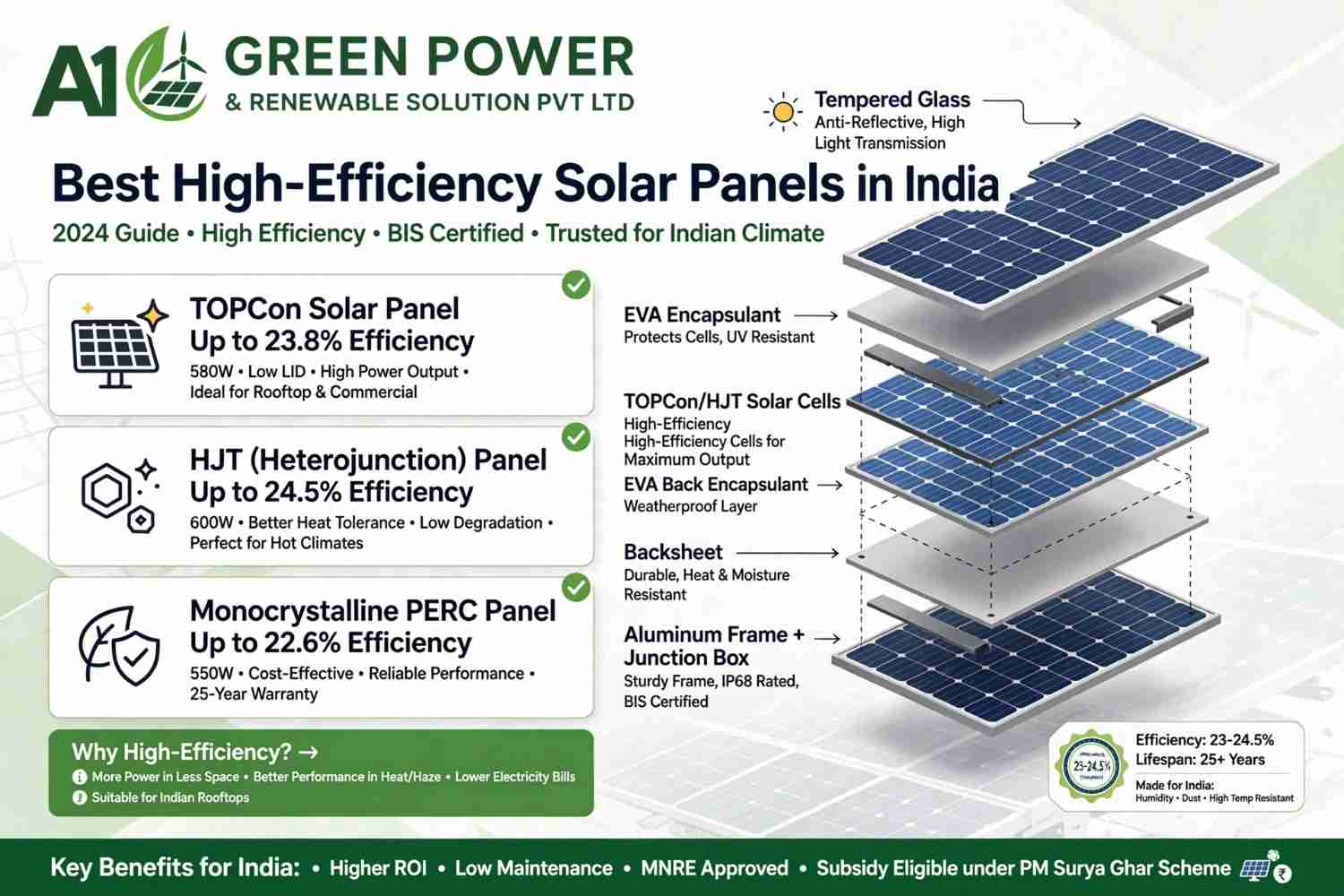
TOPCon modules are the current step up from older PERC panels — better efficiency per panel, which counts for something on a roof that isn’t huge. What I’d actually check is the warranty terms, not just the wattage. A1 Green Power’s TOPCon panels, made at its Sonipat, Haryana plant, carry a 15-year product warranty and a 30-year linear performance warranty, with in-house testing for PID, salt-mist corrosion, and thermal cycling before anything ships.
What Happens When the Power Actually Goes Out
Standard grid-tied solar shuts off during a blackout — that’s the anti-islanding safety feature doing its job, but it also means no backup for you. If outages bother you, a hybrid system with LiFePO4 battery storage fixes that. A1 Green Power’s lithium batteries are rated past 6,000 deep-charge cycles and come with a 5-year comprehensive warranty, which pairs the bill savings with actual blackout protection.
Before You Sign With Anyone
- Confirm PM Surya Ghar portal registration
- Confirm the panels are BIS-certified and ALMM-listed
- Get an itemized written quote, not a lump sum
- Make sure they’re handling DISCOM feasibility and net metering paperwork, not leaving it to you
- Get separate warranty documentation for panels, inverter, and battery
Frequently Asked Questions
1. How much does solar panel installation in Delhi cost after subsidy? A 3 kW system priced around ₹1,90,000–₹2,15,000 before subsidy typically comes down to somewhere between ₹85,000 and ₹1,10,000 once you claim the full ₹1,08,000 combined central-and-state subsidy.
2. How long does the whole process take, start to finish? Usually 30–45 days from DISCOM feasibility approval through to net meter commissioning — assuming the paperwork is filed correctly the first time around, which honestly is where most delays actually come from.
3. Can I install solar if I live in a flat, not an independent house? Yes, either through your own individual DISCOM connection and net metering agreement, or through Group Net Metering if your society sets it up for shared rooftop space.
4. Will my system keep working during a power cut? Not a standard grid-tied one — it shuts off automatically for safety. You’d need a hybrid setup with battery storage for backup during outages.
5. Do I have to pay the subsidy back at some point? No. Both the PM Surya Ghar and Delhi subsidies are direct bank transfers, not loans, and they’re not clawed back from future electricity bills.
6. How do I know if I’m with BRPL, BYPL, or TPDDL? Check your electricity bill — it’ll list your DISCOM, and that’s who your installer needs to file feasibility and net metering paperwork with.
Is It Actually Worth It?
If you’re paying ₹3,000 or more a month and your roof gets decent sun, the numbers genuinely work in your favor right now. Subsidies covering close to 40% of the cost, a faster DERC approval process, and a payback window of 4 to 6 years — that’s a hard combination to argue against, financially or environmentally.
What actually decides whether you’re happy with the system in year 10, though, isn’t the subsidy — it’s whether the installer used decent panels and sized the inverter correctly. A cheap system with weak warranties will underperform quietly for years before anyone notices.
If you’d rather talk to someone than keep reading, A1 Green Power & Renewable Solution Pvt. Ltd. manufactures TOPCon panels and LiFePO4 batteries out of its Sonipat facility, backed by 15-year product and 30-year linear performance warranties. Reach out for a site visit and a written quote before committing to anyone.







Leave A Comment