

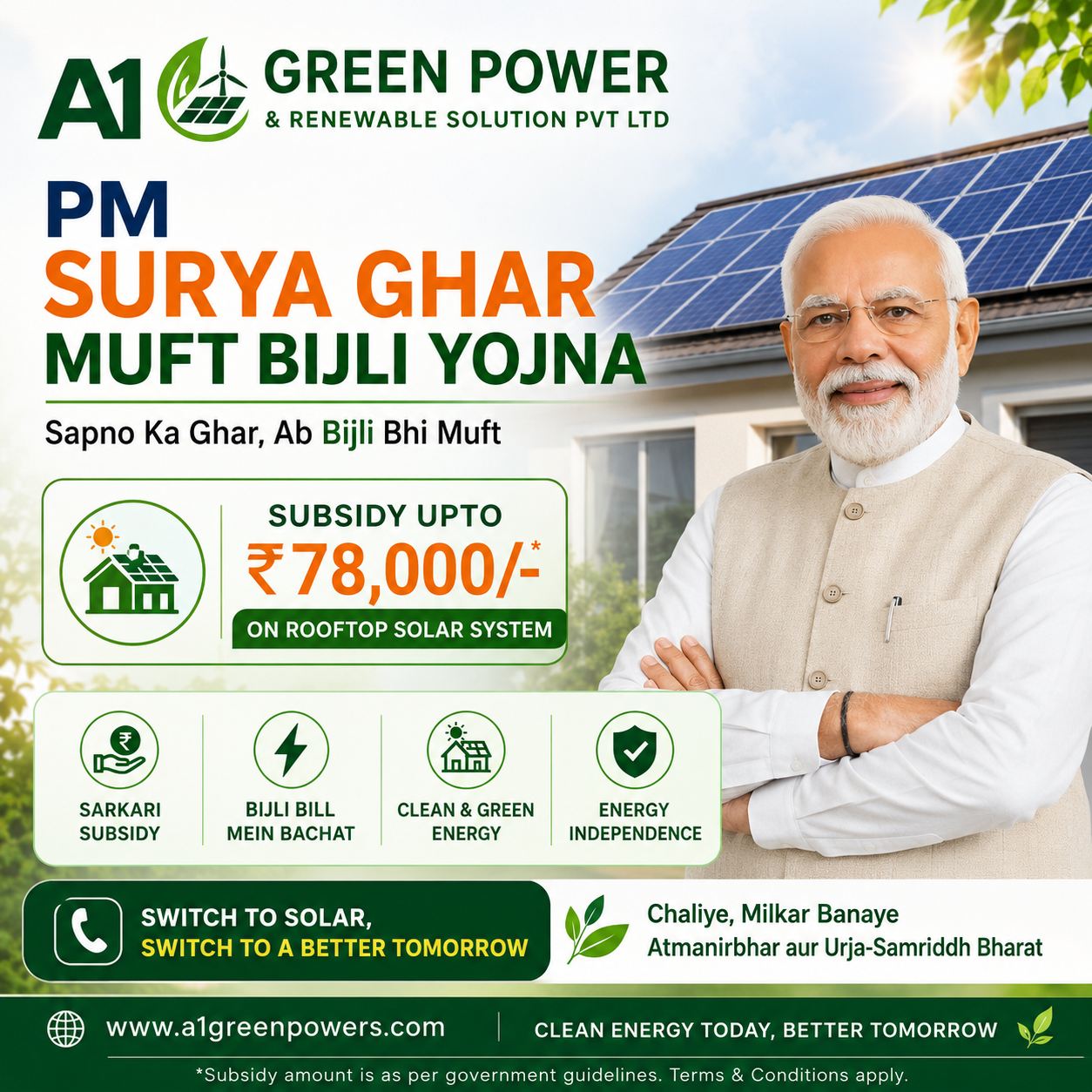
PM Surya Ghar Muft Bijli Yojana:
Electricity costs are a part of monthly household expenses and many Indian families are trying to find good ways to use less power from the regular electricity grid.
To help more people use power at home, the Government of India started the PM Surya Ghar: Muft Bijli Yojana. This plan helps families install rooftop solar systems and use less electricity from the grid.
The plan was started to help one crore households install panels. It has a budget of ₹75,021 crore. The government also said that homes can get up to 300 units of electricity each month from the power they generate.
For people thinking about putting panels on their homes, it is important to know about the PM Surya Ghar subsidy, who can apply, how to apply and what the benefits are before they decide to go ahead.
In this guide, we explain everything you need to know about the PM Surya Ghar Muft Bijli Yojana.
What is PM Surya Ghar Muft Bijli Yojana?
PM Surya Ghar: Muft Bijli Yojana is an initiative of the Government of India focused on expanding solar installations for residential electricity consumers.
The scheme provides financial Assistance to eligible residential consumers for installing grid-connected rooftop solar systems
The broader objective is to:
- Promote residential rooftop solar
- Reduce electricity bills
- Increase the use of renewable energy
- Encourage energy independence
- Reduce dependence on other electricity sources
- Support India’s clean-energy transition
The official scheme framework provides financial assistance for eligible residential rooftop solar systems, with the maximum central assistance reaching ₹78,000 under the applicable structure.
How Much Subsidy is Available Under PM Surya Ghar Muft Bijli Yojana?
One of the most important questions for homeowners is:
“How much subsidy can I get for rooftop solar?”
Under the scheme’s published structure, residential consumers can receive financial assistance based on the eligible rooftop solar capacity.
The original scheme structure provides:
| Rooftop Solar Capacity | Central Financial Assistance |
|---|---|
| First 2 kW | ₹30,000 per kW |
| Additional capacity up to 3 kW | ₹18,000 per kW |
| Capacity above 3 kW | No additional central CFA |
This results in a maximum central subsidy of ₹78,000 for eligible residential installations of 3 kW or more under the published structure.
Who Can Benefit From PM Surya Ghar Muft Bijli Yojana?
The scheme primarily focuses on residential electricity consumers who install eligible grid-connected rooftop solar systems.
A rooftop solar installation eligible for CFA is connected to the consumer’s residential electricity connection with the local distribution company (DISCOM).
The scheme framework covers rooftop installations on locations such as:
- Roofs
- Terraces
- Balconies
- Elevated structures
subject to the applicable scheme requirements.
Homeowners should also check the latest requirements applicable in their state and with their electricity distribution company before installation.
What are the Benefits of PM Surya Ghar Yojana?
Installing rooftop solar under the PM Surya Ghar Yojana can bring benefits.
1. Government Subsidy
The main draw of PM Surya Ghar Muft Bijli Yojana is the Central Financial Assistance that eligible households can receive.
The subsidy can lower the cost of installing a rooftop solar system a lot.
2. Lower Electricity Bills
Solar panels make electricity from sunlight letting households produce part of their power.
This can cut the amount of grid electricity bought. May lower monthly bills depending on:
- Solar system size
- Household consumption
- Rooftop conditions
- Solar generation
- Electricity tariff
- Net‑metering arrangements
3. Renewable Energy
Solar energy is a source of power.
Installing rooftop solar lets households take part in India’s move to energy.
4. Long-Term Energy Savings
A well‑designed rooftop solar system can keep producing electricity for years.
This turns solar into a long‑term energy investment, not a quick savings trick.
5. Greater Energy Independence
Making power at home can cut dependence on sources under normal conditions.
For homeowners seeking control, over power use rooftop solar can be a go‑to choice.
How Does PM Surya Ghar Muft Bijli Yojana Work?
The basic process involves several stages.
Step 1: Register Through the Official Portal
Consumers can begin the rooftop solar application process through the official PM Surya Ghar platform.
The scheme is implemented through the national portal for rooftop solar.
Step 2: Provide Electricity Connection Details
The consumer needs to provide relevant electricity connection and personal information required by the portal.
Step 3: Select an Eligible Vendor
After the required approvals and process steps, the consumer can proceed with an eligible rooftop solar installation.
Step 4: Install the Solar System
The selected vendor installs the rooftop solar system according to applicable technical and scheme requirements.
Step 5: DISCOM Inspection and Verification
The distribution company carries out the required inspection and verification process.
The applicable documentation and net-metering process are completed according to the rules applicable to the installation.
Step 6: Subsidy/CFA Processing
After successful installation and verification, the applicable Central Financial Assistance is processed according to the scheme’s procedures.
The official rooftop solar framework states that CFA is transferred to the beneficiary’s account or, where applicable, the loan account.
What is the Role of Net Metering?
Net metering can play an important role in grid-connected rooftop solar systems.
During periods when your solar system generates more electricity than your home is consuming, the surplus electricity can be exported to the electricity grid according to the applicable state regulations and DISCOM arrangements.
At other times, your home can draw electricity from the grid.
This helps create a two-way relationship between the rooftop solar system and the electricity grid.
However, net-metering rules, procedures and availability can vary according to state regulations and the concerned DISCOM.
How Many Solar Panels Do You Need for Your Home?
The required solar capacity depends on your electricity consumption and available rooftop space.
For example, a household with relatively low electricity consumption may require a smaller system, while a household with higher consumption may benefit from a larger installation.
Before deciding on a system size, homeowners should consider:
- Average monthly electricity consumption
- Electricity bills from previous months
- Available roof area
- Roof orientation
- Shading
- Local sunlight conditions
- Desired electricity generation
- Future electricity requirements
- Budget
A professional solar assessment can help determine an appropriate system size.
Is 3 kW Solar System Suitable for a Home?
A 3 kW rooftop solar system is a popular consideration for residential applications because the scheme’s published CFA structure provides the maximum central subsidy at 3 kW of eligible capacity.
However, that does not mean every household should automatically install a 3 kW system.
The ideal capacity should be based on the household’s electricity consumption and technical site conditions.
For example, a home with significantly higher electricity consumption may require a larger system.
A larger system may still be installed, but under the published CFA structure, additional capacity beyond 3 kW does not receive additional central CFA.
What Solar Equipment is Required?
A typical grid-connected rooftop solar system may include:
Solar Panels
Solar panels convert sunlight into DC electricity.
Solar Inverter
The inverter converts the electricity generated by solar panels into usable AC electricity for household appliances and grid interaction.
Mounting Structure
The mounting structure securely positions the solar panels on the rooftop.
Protection Equipment
Electrical protection equipment helps protect the system and household electrical infrastructure.
Metering Equipment
Depending on the applicable arrangement, appropriate metering equipment is installed for grid-connected operation and energy accounting.
For systems that also require backup power, batteries and appropriate hybrid/off-grid equipment may be considered depending on the consumer’s requirements.
Can You Use a Battery With Rooftop Solar?
Yes, solar batteries can be considered when backup power is an important requirement.
A standard grid-connected rooftop solar system and a battery-backed solar system are not exactly the same.
A battery can store excess solar energy and provide backup power when required, subject to the system configuration.
For homeowners who experience frequent power cuts, a hybrid solar inverter with a suitable battery system can be worth considering.
This is where choosing the right inverter and battery becomes important.
A1 Green Powers offers energy solutions including hybrid inverters, lithium batteries and solar products designed for residential and other applications.
PM Surya Ghar vs Traditional Electricity: Why Consider Solar?
Traditional grid electricity requires consumers to purchase electricity continuously from the distribution network.
Rooftop solar changes this model by allowing consumers to generate electricity at their own property.
The benefits can include:
Traditional Electricity
- Continuous dependence on grid supply
- Monthly electricity expenses
- Exposure to changing electricity tariffs
- No electricity generation at the property
Rooftop Solar
- Generates electricity from sunlight
- Can reduce grid electricity consumption
- Can lower long-term electricity costs
- Uses renewable energy
- Can increase household energy independence
The actual financial benefit depends on the system, consumption, tariffs, installation cost and local regulations.
Common Mistakes to Avoid Before Installing Rooftop Solar
1. Choosing a System Only Because of the Subsidy
Do not select a solar system size only because it provides a particular subsidy.
Your system should match your electricity consumption and available rooftop space.
2. Ignoring Roof Shading
Shade from trees, buildings, water tanks or other structures can reduce solar generation.
A proper site assessment is important.
3. Choosing Equipment Only on Price
The cheapest solar system is not necessarily the best system.
Consider:
- Product quality
- Warranty
- Efficiency
- Installation quality
- After-sales service
- Technical support
4. Not Checking DISCOM Requirements
Rooftop solar is connected to the electricity network, so consumers should understand the applicable DISCOM procedures before installation.
5. Not Planning for Future Electricity Requirements
If you plan to purchase an electric vehicle, install additional air conditioners or significantly increase electricity consumption, consider those future requirements when designing your solar system.
Why Choose A1 Green Powers for Solar Energy Solutions?
At A1 Green Powers, our focus is on providing reliable energy solutions for homes, businesses and other applications.
Our product portfolio includes:
- Solar panels
- Hybrid inverters
- Lithium batteries
- Inverter solutions
- Solar energy systems
A good solar installation is not only about buying solar panels. The inverter, battery, protection equipment, installation quality and after-sales support also play an important role.
Our goal is to help customers choose energy solutions that match their actual power requirements.
If you are planning to install rooftop solar under the PM Surya Ghar Muft Bijli Yojana, our team can help you understand the equipment and system requirements involved in a solar installation.
Frequently Asked Questions About PM Surya Ghar Muft Bijli Yojana
What is PM Surya Ghar Muft Bijli Yojana?
PM Surya Ghar Muft Bijli Yojana is a Government of India initiative that promotes residential rooftop solar installations and provides Central Financial Assistance to eligible residential consumers.
How much subsidy is available under PM Surya Ghar?
The published central subsidy structure provides ₹30,000 per kW for the first 2 kW and ₹18,000 for an additional kW up to 3 kW, resulting in a maximum central subsidy of ₹78,000 for eligible residential installations.
Is PM Surya Ghar available for residential consumers?
Yes. The residential component of the scheme provides CFA for eligible grid-connected rooftop solar installations associated with residential electricity connections.
Can I install more than 3 kW solar?
Yes, a larger rooftop solar system may be installed where appropriate. However, under the published CFA structure, there is no additional central subsidy beyond the eligible 3 kW level.
Can I use solar batteries with my solar system?
Yes. Batteries can be integrated into suitable solar system configurations, particularly where backup power or energy storage is required.
Does rooftop solar completely eliminate the electricity bill?
Not necessarily.
The amount you save depends on your solar generation, electricity consumption, system size, tariffs, net-metering arrangements and other factors.
The term “Muft Bijli” should therefore not be interpreted as a guarantee that every household will always have a zero electricity bill.
Where can I apply for PM Surya Ghar?
The scheme is implemented through the official national rooftop solar portal. Consumers should use the official government portal and follow the latest application procedure.




Leave A Comment