

Introduction
Everyone claims to sell the best solar panel in India. Walk into any electrical market in Delhi or scroll through IndiaMART for ten minutes and you’ll see a dozen brands, each promising the highest efficiency and the lowest price. Most of that noise doesn’t help you make an actual decision.
Here’s the thing: a solar panel isn’t something you swap out next year if you don’t like it. It sits on your roof for 25 to 30 years, through every summer heatwave and monsoon downpour your city throws at it. Get the choice wrong and you’re stuck with underperforming output for a couple of decades, not a couple of months.
I’ve spent the last several years around solar installations and manufacturing floors, and the questions people ask are almost always the same: which technology actually works better, how much subsidy can I realistically get, and which brands are worth trusting. This guide answers all three, without the sales pitch.
Why the Panel You Pick Actually Matters
A cheap panel and a good panel might look identical sitting on a rooftop. The difference shows up years later, in your electricity bill.
What a Bad Choice Costs You
Low-quality panels degrade faster than people expect — often losing more than 1% of their output every single year. A premium TOPCon module, by comparison, typically loses under 0.4% annually. That gap sounds small until you run the numbers over 25 years. It adds up to real money left on the table.
Indian Weather Is Not Gentle on Equipment
Rooftop temperatures in Rajasthan or Vidarbha can push past 45°C in peak summer. Then the monsoon arrives with weeks of humidity and rain. Add dust storms in the north and salty coastal air down south, and you start to understand why a panel built for European or Chinese climate data sheets doesn’t always hold up here the way the specs suggest.
That’s really the core of it: the best solar panel in India isn’t necessarily the one with the flashiest efficiency number on paper. It’s the one engineered — or at least properly tested — for these specific conditions.
It Also Depends on Where You Live
A panel that thrives in Gujarat’s dry heat might behave differently in Kerala’s humidity. Rajasthan and Gujarat deal with intense sun and dust, so anti-soiling coatings matter a lot there. Coastal states like Kerala, Odisha, and parts of Tamil Nadu need corrosion-resistant frames because of the salt in the air. And up in Punjab, Haryana, and UP, thick winter fog can blanket the plains for weeks, which makes low-light performance more important than most people realize. If a manufacturer only tests for one climate profile, that’s worth asking about.
The Main Types of Solar Panels You’ll Come Across
Monocrystalline (Mono PERC)
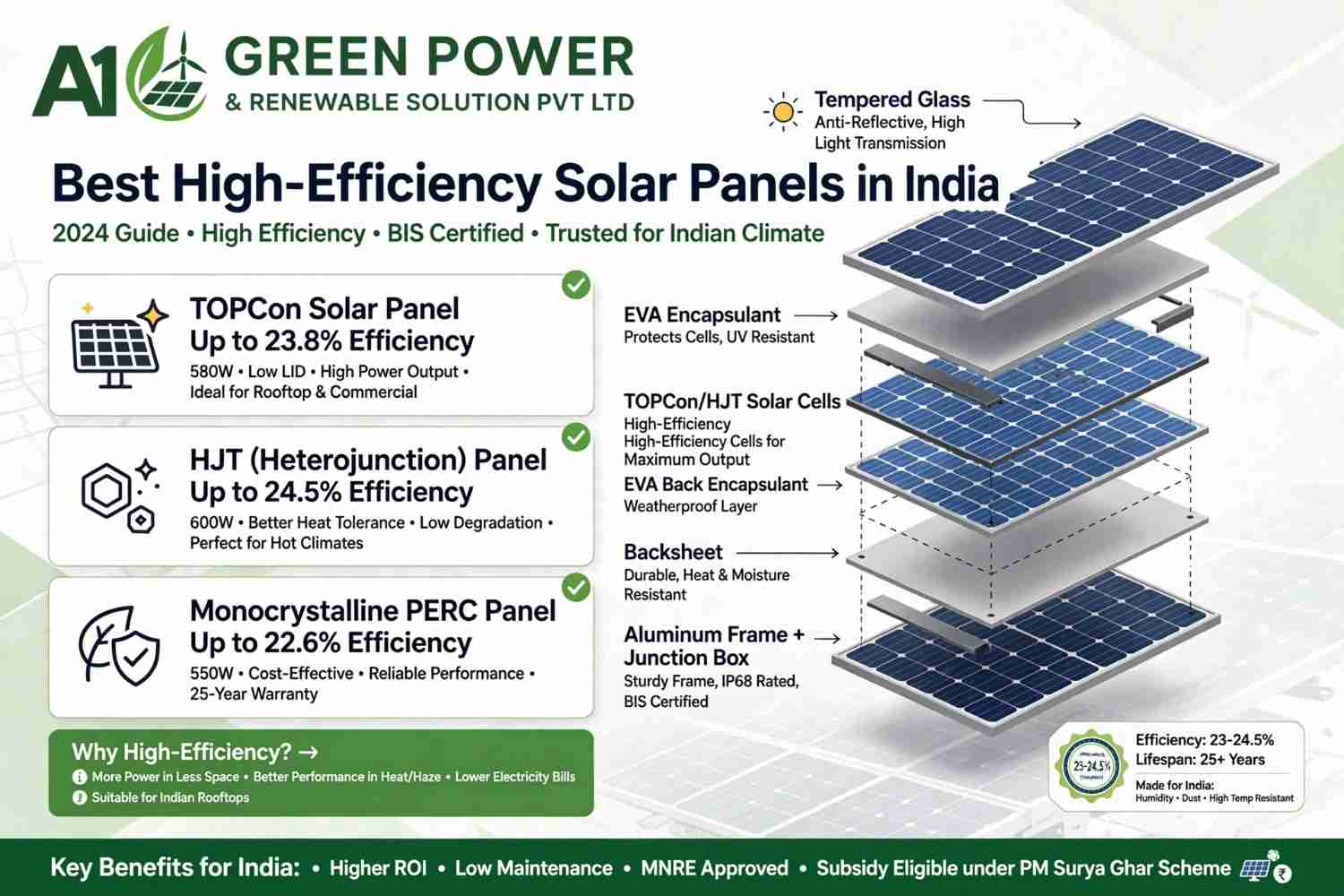
This is still the default choice for most Indian homes, and for good reason. Efficiency usually sits between 19% and 21%, the price is reasonable, and it holds up well on rooftops. If you’re not sure where to start, Mono PERC is a safe middle ground.
TOPCon Panels
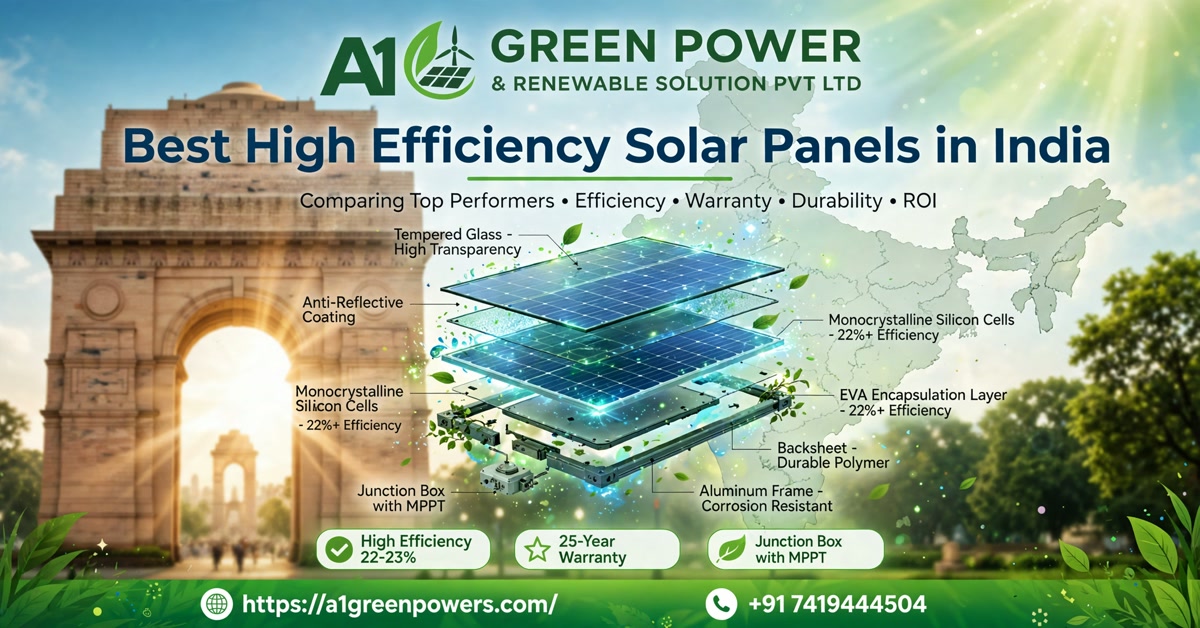
TOPCon — short for Tunnel Oxide Passivated Contact — is the newer technology, and it’s genuinely better in a few measurable ways: higher efficiency, stronger performance on cloudy or hazy days, and a slower degradation curve. Indian manufacturers now produce TOPCon modules ranging from 500W up to 715W, which is a big jump from what was available even three years ago.
Bifacial Modules
These capture sunlight on both the front and back of the panel, so they generate a bit of extra output when mounted above a reflective surface — think white gravel or a light-colored terrace floor. They make more sense for ground-mounted or commercial setups than for a typical residential roof.
Polycrystalline
The old workhorse. Less efficient per square foot than the newer options, but if you’ve got plenty of roof space and a tight budget, it still gets the job done.
| Panel Type | Typical Efficiency | Best For | Relative Price |
|---|---|---|---|
| Polycrystalline | 15–17% | Large roofs, tight budgets | Lowest |
| Mono PERC | 19–21% | Most residential rooftops | Moderate |
| TOPCon | 21–23%+ | Homes and commercial roofs wanting maximum output | Moderate to high |
| Bifacial | 21–23%+ (plus rear gain) | Ground-mount, commercial, open terraces | High |
Treat this table as a rough starting point, not gospel — always check the actual datasheet, since numbers shift between product lines even within the same brand.
What to Actually Check Before You Buy
Efficiency and Wattage
Higher wattage panels mean fewer panels for the same total output. That saves roof space and cuts down installation labor. But don’t stop at wattage — check the efficiency rating too, since two panels rated at similar wattage can have different physical sizes and performance curves.
Warranty, in Writing
A reputable manufacturer stands behind a 12 to 15 year product warranty, plus a 25 to 30 year linear performance warranty. If a seller can’t produce these terms in writing, walk away. Verbal promises don’t hold up when a panel underperforms in year eight.
BIS Certification
This one’s non-negotiable. BIS (Bureau of Indian Standards) certification is legally required for panels sold in India, and it also affects whether you qualify for government subsidy. Ask to see it, don’t just take someone’s word for it.
Price Per Watt, Not Total Price
Comparing total system cost across quotes is misleading if the system sizes differ. Break it down to rupees per watt instead — it’s the only way to spot an inflated quote.
Who’s Actually Making It
Look for manufacturers doing their own EL (electroluminescence) testing and third-party quality checks in-house, not just assembling imported cells. Indian-made panels also tend to qualify for DCR (Domestic Content Requirement) subsidy categories, which matters a lot if you’re applying for government assistance.
Getting Your Panels Installed Right
Buying a good panel is maybe half the job. The rest comes down to installation and a little ongoing care.
Orientation and Tilt
Most locations in India get the best annual output from panels facing true south, tilted close to the local latitude. This isn’t something to eyeball — a decent installer will calculate it for your specific roof.
Watch Out for Shade
Even a partial shadow from a water tank or an overhanging tree branch can drag down the output of an entire string of panels, depending on how they’re wired. Before installation, have someone actually map out how shade moves across your roof through the day.
Cleaning
Dust cuts into output more than people expect, especially in the dry months across northern and western India. A wipe-down every two to four weeks with water and a soft brush is usually enough — skip the harsh chemicals, they can damage the coating.
Keep an Eye on Performance
Most modern inverters come with an app that shows daily generation numbers. Checking it now and then helps you catch a faulty panel or a loose connection before it quietly costs you weeks of lost output.
Government Subsidy: What You Can Actually Claim
The scheme that’s changed the math for most Indian households is the PM Surya Ghar: Muft Bijli Yojana, launched in February 2024 with a total outlay of ₹75,021 crore.
The Numbers
| System Size | Approximate Subsidy |
|---|---|
| 1 kW | ₹30,000 |
| 2 kW | ₹60,000 |
| 3 kW or higher | ₹78,000 |
Source: Ministry of New and Renewable Energy, PM Surya Ghar scheme guidelines.
Who Qualifies
Any residential household with a grid-connected electricity meter can apply through the scheme’s national portal. There’s also access to collateral-free loans at reduced interest rates for whatever the subsidy doesn’t cover.
The Catch
Only panels meeting DCR and BIS requirements are eligible. That means the cheapest unverified import you found online might not qualify for subsidy at all, even if it looks like a good deal upfront.
A Word on Brands
India’s solar manufacturing scene has grown fast, and there are now real domestic alternatives to imported panels — often at competitive prices and with better local support.
Why Domestic Manufacturing Has an Edge
Locally made panels tend to come with faster after-sales service, DCR eligibility for subsidies, delivery timelines that don’t depend on shipping delays, and — often overlooked — designs actually calibrated for Indian heat and dust rather than a European climate profile.
Where A1 Green Power Fits In
A1 Green Power & Renewable Solution Pvt. Ltd., based in Sonipat, Haryana, manufactures TOPCon modules from 500W up to 715W, including glass-to-glass and bifacial variants. Their panels carry a 15-year product warranty and a 30-year linear performance warranty, backed by in-house EL testing along with PID, salt-mist, and thermal cycling checks.
A Few Red Flags Worth Knowing
Be cautious if a seller won’t share the official datasheet, quotes a price well below market average without explaining why, or can’t produce a valid BIS certificate when asked. A real manufacturer has a physical facility you can point to — not just a slick website and a WhatsApp number.
Questions Worth Asking Before You Sign Anything
- What’s the exact efficiency rating and degradation curve — in writing?
- Is the panel BIS certified and DCR eligible?
- What do the warranty terms actually say, not just what the salesperson promises?
- Is there real local installation and after-sales support, or does it stop after the sale?
Wrapping Up
Finding the best solar panel in India really comes down to matching your budget and roof space with a technology you trust and a manufacturer who’ll still answer the phone in year five. TOPCon currently leads on efficiency and long-term value; Mono PERC remains a solid, dependable middle path. Whatever you choose, don’t skip the boring checklist — BIS certification, warranty terms in writing, DCR eligibility.
Before signing anything, get a written quote that breaks out panel wattage, technology, warranty terms, and installation cost separately. It’s a lot easier to compare offers that way, and it stops hidden charges from sneaking in later. Ask around, check reviews, and if you can, talk to someone who’s already had panels installed by the vendor you’re considering.
Ready to go solar? Get a free quote from A1 Green Power today and take the first step toward lower electricity bills and real energy independence.
Frequently Asked Questions
What is the best solar panel in India for home use? For most homes, something in the 400W to 550W range using Mono PERC or TOPCon technology hits the right balance of efficiency, price, and available roof space.
How much does a solar panel system cost in India? It varies by capacity, brand, and installation complexity, but the PM Surya Ghar subsidy takes a meaningful chunk off the upfront cost for systems up to 3 kW.
Is TOPCon actually better than Mono PERC? For the most part, yes. TOPCon panels run more efficient, hold up better in low light, and degrade slower over time compared to standard Mono PERC.
Do I need any government approval to install solar panels? You’ll need net metering approval from your local DISCOM, and if you want the subsidy, registration on the PM Surya Ghar national portal.
How long do solar panels actually last? Good ones come with 25 to 30 year linear performance warranties — meaning they’re guaranteed to keep generating at least a minimum output for decades, not just a few years.
Are Indian-made panels really as good as imported ones? Increasingly, yes. Several Indian manufacturers now produce TOPCon and bifacial panels that match or beat international standards, and you get local subsidy eligibility as a bonus.
What warranty should I expect at minimum? Aim for at least a 12-year product warranty and a 25-year linear performance warranty. Anything shorter should raise questions.




Leave A Comment