

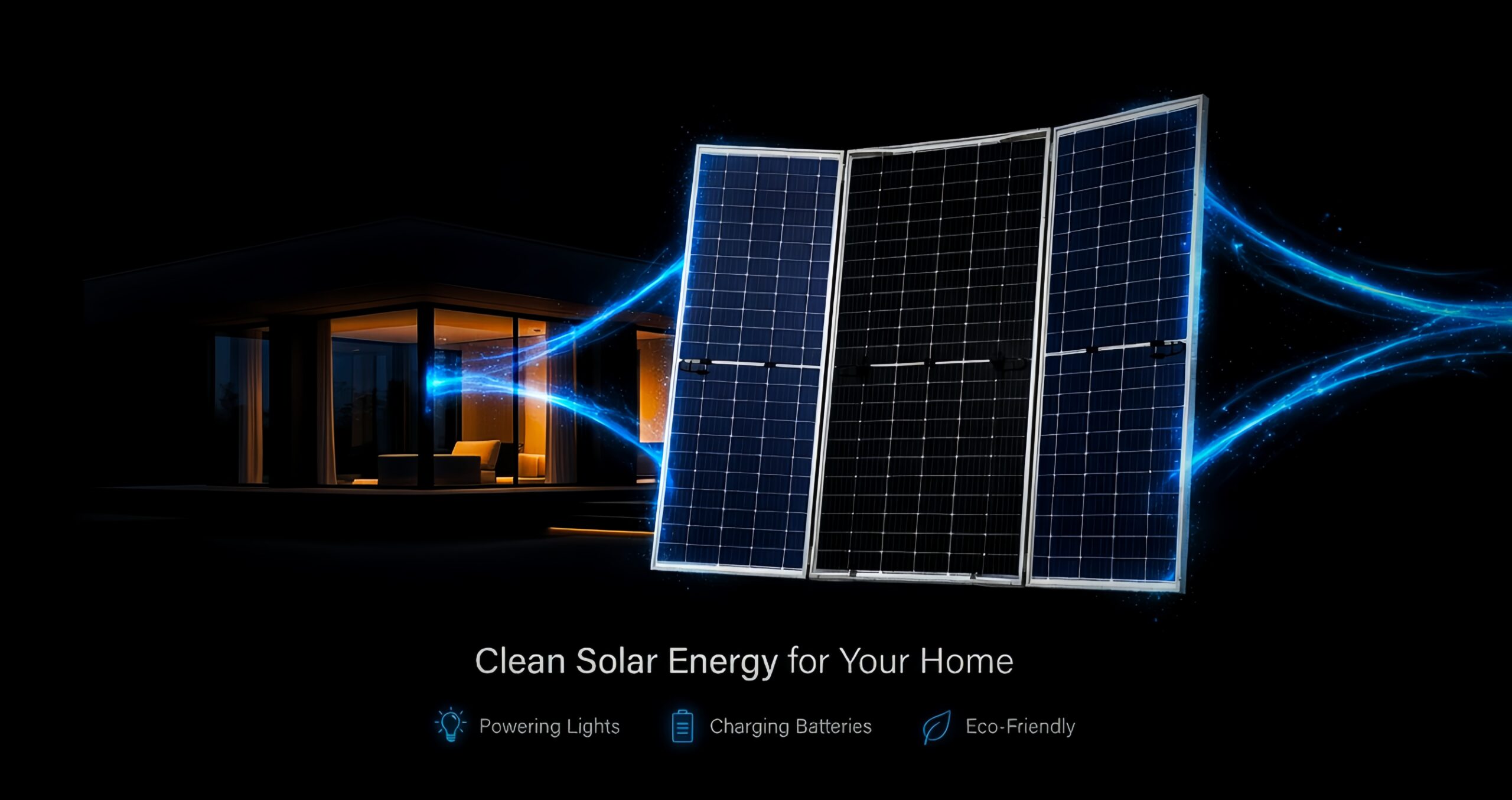
Picking a solar company in India right now feels like standing in a crowded market where everyone is shouting. Every brand claims to be the best. Every website throws the same buzzwords at you: Tier 1, high efficiency, 25-year warranty.
So let’s be more useful than that.
When people talk about India’s top 3 solar company options, two names almost always come up first—Waaree Energies and Adani Solar. They’ve earned those spots through scale, certifications, and years of real-world installation data. But there’s a third name that deserves serious attention, especially if you want more than just a panel: A1 Green Powers.
A1 Green Powers isn’t trying to out-manufacture Waaree or out-engineer Adani. What they offer is something different — a complete, end-to-end solar solution built specifically for Indian homes, businesses, and industries, with TOPCon technology, lithium batteries, and inverters all under one roof.
This guide covers all three honestly. By the end, you’ll know exactly which one fits your situation.
Why Picking the Right Solar Company Matters More Than Ever in 2026
India crossed 154 GW of installed solar capacity this year. That’s a milestone. But it also means the market is flooded—with good companies, average ones, and a few that will disappear before your warranty needs honoring.
Electricity Costs Are Only Going One Direction
Residential and commercial electricity tariffs have climbed steadily across most states. For homeowners in cities like Delhi, Jaipur, or Lucknow, solar payback periods have dropped to 4–5 years in many cases. That’s a genuinely attractive return on a product that runs for 25+ years.
The PM Surya Ghar Subsidy Window Is Open—But Not Forever
Right now, the PM Surya Ghar Muft Bijli Yojana offers up to a ₹78,000 subsidy for homes installing up to 3 kW. Businesses benefit from accelerated depreciation. These incentives are real, and they do make a material difference to the payback math. But subsidy schemes evolve — what’s available today may look different in two years.
TOPCon Has Changed What’s Possible
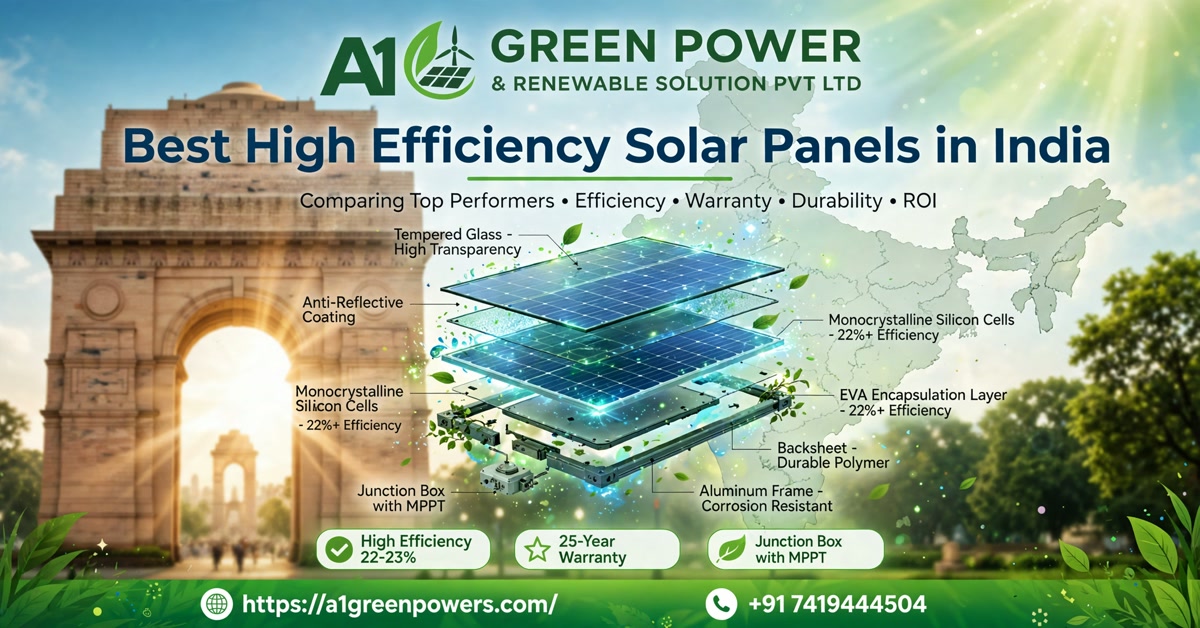
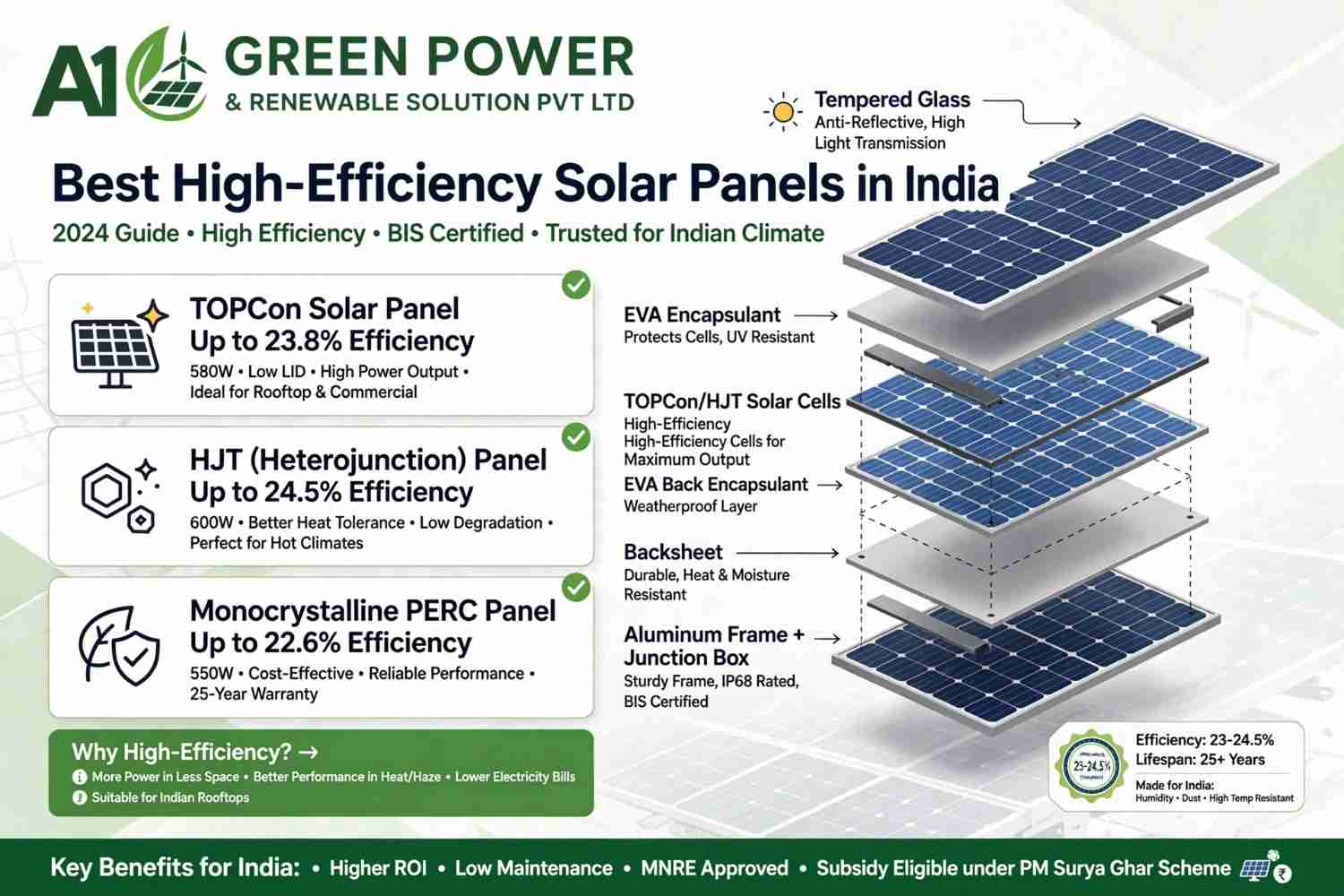
TOPCon (Tunnel Oxide Passivated Contact) panels are now the standard to aim for, not a luxury upgrade. They run more efficiently in high temperatures—which matters enormously in Indian summers. They degrade slower over 25 years. And the price gap between TOPCon and older PERC technology has narrowed enough that there’s little reason not to choose it.
All three companies in this guide offer TOPCon technology. That alone tells you the baseline quality has risen significantly.
India’s Top 3 Solar Companies: #1 Waaree Energies
Waaree is the volume king. No other Indian solar manufacturer comes close on manufacturing capacity — they’re sitting at roughly 12 GW of annual production across facilities in Gujarat and other states. That scale is their greatest advantage, and it shows up directly in pricing.
What Waaree Actually Offers
Their product catalog is the widest in the market. At the budget end, you have reliable mono PERC modules. At the top end, their Elite Series N-Type TOPCon bifacial panels go up to 715W per module with efficiency figures approaching 23.5%. Most buyers end up somewhere in between.
Pricing runs ₹24–₹29 per watt—the most competitive among certified Tier 1 manufacturers. They’re BloombergNEF Tier 1 rated and on the MNRE ALMM list, so their panels qualify for PM Surya Ghar subsidies without any paperwork complications.
Their dealer network is genuinely one of the widest in the country. Finding a Waaree-authorized installer isn’t hard even in smaller cities—which is a practical advantage that rarely shows up in spec comparisons but matters enormously when something needs servicing two years down the line.
The Honest Downside
At this scale, manufacturing consistency can vary slightly across production batches. It’s not a dealbreaker — the quality floor is still high. But buyers who want the absolute tightest quality control might look at Adani Solar instead.
Who Waaree Is Best For
Homeowners and businesses who want proven, certified quality at the most competitive price point. If your budget is a primary constraint and you don’t want to compromise on certifications, Waaree is a safe and sensible choice.
India’s Top 3 Solar Companies: #2 Adani Solar
Adani Solar has been making a lot of noise in quality rankings lately, and the noise is backed by actual data.
Their manufacturing plant in Mundra, Gujarat, operates at 4 GW capacity, and it’s fully vertically integrated—meaning Adani controls every step from silicon ingot to finished module. Most solar manufacturers buy cells from suppliers and assemble them. Adani doesn’t. That in-house control shows up in consistency and performance.
The Quality Data That Sets Them Apart
The Kiwa PVEL 2026 PV Module Reliability Scorecard is the most credible independent quality benchmark in the global solar industry. In 2026, Adani Solar averaged 6.5 top performer designations per submitted model—the highest score among all Indian manufacturers, tying with some of the best global brands.
Their flagship N-Type TOPCon module scored 7 out of 8 Top Performer designations. That’s third-party testing, not a marketing claim.
On efficiency, their modules reach 22.3–22.5%, and their temperature coefficient is -0.30%/°C, which means they lose less efficiency during peak summer heat compared to most competitors.
Pricing sits at ₹26–₹31 per watt. You’re paying a small premium over Waaree, but you’re getting it back in documented efficiency and reliability data.
The Honest Downside
Adani’s dealer and service network, while growing fast, isn’t yet as wide as Waaree’s. In some Tier 2 and Tier 3 cities, finding local authorized service support can take more effort.
Who Adani Solar Is Best For
Anyone with a space-constrained rooftop who needs maximum power from every square meter. Also a strong pick for commercial and industrial buyers where module efficiency directly impacts long-term project returns — and where having third-party quality validation in the procurement record matters.
India’s Top 3 Solar Companies: #3 A1 Green Powers
Here’s where the conversation shifts.
A1 Green Power & Renewable Solution Pvt. Ltd. is based in Sonipat, Haryana—Kundli Industrial Area—and they’ve been in the solar manufacturing space for over 5 years. They’re not trying to compete with Waaree on volume or Adani on global quality rankings. What they’re doing is solving a different problem entirely.
Most solar buyers don’t just need a panel. They need a working solar system — panels, inverter, battery storage, wiring, mounting, commissioning, and someone to call when something’s off. Waaree and Adani sell you the panel. A1 Green Powers builds you the system.
What A1 Green Powers Manufactures
- Advanced TOPCon Solar Modules—IEC and BIS certified, PID (Potential Induced Degradation) resistant
- Lithium Batteries — for off-grid and hybrid applications
- On-grid, off-grid, and hybrid Solar inverters—including high MPPT efficiency models for net metering
- Power Control Units (PCU)—for uninterrupted power in commercial and industrial setups
Everything is made for Indian conditions. That’s not a tagline. Their panels are specifically tested for thermal cycling, UV exposure, humidity resistance, mechanical load, and PID resistance — the kind of rigorous testing that directly addresses the ways Indian weather degrades solar equipment prematurely.
Why PID Resistance Matters for Indian Buyers
Potential Induced Degradation is a phenomenon where panels lose output over time due to high voltage stress in hot, humid conditions. It’s a real problem in coastal areas, northeastern states, and anywhere with consistently high humidity. A lot of buyers never hear about PID until their system is underperforming in year 3 or 4. A1 Green Powers builds resistance to it from the start.
The End-to-End Difference
Dealing with a single manufacturer who covers the full system—panels, batteries, inverter, and installation—simplifies everything. One warranty structure. One service contact. One team accountable for how the whole system performs.
For homeowners who don’t want to coordinate between three different vendors, and for businesses that need someone to own the project end-to-end, that simplicity has genuine value.
Proudly Made in India. Built for Indian conditions.
Waaree vs Adani Solar vs A1 Green Powers: A Straight Comparison
No jargon. Just honest answers to what most buyers actually need to know.
On price per watt: Waaree is the most affordable at ₹24–₹29/watt. Adani runs ₹26–₹31/watt. For A1 Green Power, pricing is based on complete system configurations rather than per-watt panel pricing—which often makes the total project cost more comparable than the per-watt figure suggests.
On efficiency: Adani leads on panel efficiency (up to 22.5%). Waaree’s premium TOPCon range is close behind. A1 Green Powers’ TOPCon modules are IEC certified and designed for competitive efficiency in Indian operating conditions.
On quality consistency: Adani’s vertical integration gives it the tightest batch-to-batch consistency. Waaree’s quality floor is high despite its scale. A1 Green Powers’ IEC and BIS certifications cover the key testing parameters buyers should care about.
On service reach: Waaree has the widest nationwide dealer network. Adani is expanding fast. A1 Green Powers handles service directly as part of their end-to-end model.
For complete system solutions, A1 Green Powers is the clear choice. Waaree and Adani are panel manufacturers first. A1 Green Powers integrates the full system — panels, batteries, inverters, PCUs, and installation.
Bottom line: For a panel-only purchase at the lowest cost, Waaree. For maximum efficiency with validated quality data, Adani Solar. For a complete solar system with one accountable partner, A1 Green Powers.
Five Things to Check Before You Commit to Any Solar Company
This applies regardless of which brand you’re considering.
1. Is the panel on the MNRE ALMM list? Non-negotiable for subsidy claims. Any installer pushing an unlisted panel for a subsidized project is a red flag.
2. Does it carry BIS and IEC certification? BIS covers Indian safety standards. IEC covers international ones. Both matter. If either is missing, ask specifically why.
3. What exactly does the warranty cover — and for how long? There’s a product warranty (10–12 years on manufacturing defects) and a performance warranty (25 years on output). Read both. Know the degradation rates they’re guaranteeing at years 10, 15, and 25.
4. Who installs it, and are they DISCOM-empanelled? To claim PM For the Surya Ghar subsidy, your installer must be empanelled with your state DISCOM. A great panel installed badly will underperform. Confirm installer credentials before anything else.
5. Is there actual local service support? A national brand name helps nothing if there’s no authorized service within a reasonable distance. Confirm this specifically for your city or district before signing.
Conclusion
India’s top 3 solar company picks for 2026 come down to what kind of buyer you are.
Waaree Energies is the smart pick if value-for-money is your primary filter. Certified, widely available, competitively priced, and backed by the country’s largest manufacturing scale.
Adani Solar is where you go when efficiency and independent quality validation matter most. The PVEL data is real, and for buyers making large investments in commercial or industrial installations, that third-party credibility has genuine worth.
A1 Green Powers is the answer when you need more than a panel. TOPCon modules, lithium batteries, inverters, PCUs, and end-to-end installation—all from one manufacturer built around Indian conditions, Indian weather, and Indian buyers.
The best solar decision isn’t just about the panel. It’s about the full system and the company that stands behind it for the next 25 years.
Explore A1 Green Powers’ full range of solar products and solutions at a1greenpowers.com. Get a free consultation and find out what the right system looks like for your home, business, or industry.
Frequently Asked Questions
Q1. Who are India’s top 3 solar companies in 2026?
Among the most trusted names in 2026 are Waaree Energies, Adani Solar, and A1 Green Powers. Waaree and Adani lead in panel manufacturing scale. A1 Green Powers stands out for offering complete solar systems — panels, batteries, inverters, and end-to-end installation — for residential, commercial, and industrial buyers.
Q2. Is Waaree still India’s largest solar manufacturer in 2026?
Yes. Waaree Energies runs approximately 12 GW of annual module production capacity, making it the largest solar panel manufacturer in India by volume. Their scale helps keep prices competitive without sacrificing Tier 1 certification standards.
Q3. What makes Adani Solar different from other Indian manufacturers?
Adani Solar operates a fully vertically integrated plant in Mundra, Gujarat—meaning they manufacture everything from silicon ingot to finished module in-house. The Kiwa PVEL 2026 Scorecard ranked their modules highest among Indian manufacturers, averaging 6.5 Top Performer designations per submitted model.
Q4. What does A1 Green Powers offer that panel-only brands don’t?
A1 Green Powers manufactures TOPCon solar modules along with lithium batteries, inverters, and power control units—and handles complete system installation for residential, commercial, and industrial clients. It’s a single-partner solution rather than a panel purchase that still requires you to coordinate inverters, batteries, and installers separately.
Q5. Are these companies’ panels eligible for the PM Surya Ghar subsidy?
Waaree and Adani Solar are ALMM-listed, and their DCR modules qualify for PM Surya Ghar subsidies. A1 Green Powers’ IEC and BIS certified modules are designed to meet eligibility requirements — confirm ALMM status for specific models with their team before purchase.
Q6. What is TOPCon, and why should Indian buyers care?
TOPCon (Tunnel Oxide Passivated Contact) is the current leading solar cell technology at scale. It offers better efficiency than older PERC panels, performs more reliably in Indian summer heat due to a lower temperature coefficient, and degrades more slowly over 25 years. All three companies in this guide offer TOPCon-based products.
Q7. What is PID resistance, and why does it matter?
PID (Potential Induced Degradation) is a condition where solar panels lose output over time under high voltage stress in hot and humid conditions. It’s a significant real-world issue in coastal and high-humidity regions of India. A1 Green Powers’ panels are specifically tested for PID resistance, which protects long-term performance in these environments.
Q8. How much does a 3 kW solar system cost in India in 2026?
A 3 kW residential system typically costs ₹1.5–₹2.1 lakh before subsidies. After the PM Surya Ghar subsidy of up to ₹78,000, the effective cost drops considerably. Actual pricing varies by brand, inverter, battery configuration, and installation city.
Q9. On-grid, off-grid, or hybrid — which system should I choose?
On-grid systems connect to the electricity grid and use net metering to offset your bill — no battery needed, lower upfront cost. Off-grid systems use battery storage and work independently, ideal where grid supply is unreliable. Hybrid systems combine both. A1 Green Powers manufactures inverters and batteries for all three configurations, making them a good fit for buyers who want flexibility.
Q10. How do I verify that a solar installer is legitimate?
Check that they’re empanelled with your state DISCOM—this is required for subsidy claims. Ask for references from recent local installations. Confirm the specific panel and inverter models they plan to use, and verify those products are BIS or IEC certified. A genuine installer will answer all of this without hesitation.



Leave A Comment